
Your bedroom air quality problem almost certainly starts in your bed. Bedding sits at the center of the sleep microenvironment, acting as a reservoir for dust mites, pet dander, fungal spores, and volatile organic compounds (VOCs) that you breathe in for seven or eight hours every night. Research confirms that over 90% of U.S. bedrooms contain multiple detectable allergens, with over 73% having elevated levels such as dust mites and pet dander. The air you breathe while sleeping is shaped more by what is in your mattress and sheets than by almost any other factor in the room.
Here is why that matters practically:
- Proximity: Your face sits inches from your pillow and mattress surface for hours, concentrating your exposure to whatever those materials release.
- Movement: Every time you roll over, you resuspend settled particles back into the air directly at your breathing zone.
- Heat and humidity: Your body temperature and sweat accelerate chemical off-gassing from mattress foams, increasing VOC concentrations overnight.
- Accumulation: Mattresses are used for many years, collecting sweat, skin cells, and allergens throughout without any self-cleaning mechanism.
- Misconception: Clean sheets do not equal a clean bed. The mattress interior is where allergens truly accumulate, and surface washing never reaches it.
Understanding the connection between bedding hygiene and the air you breathe is the first step toward doing something about it.
How bedding affects indoor air quality and allergen exposure
Bedding does not just hold allergens passively. It actively releases them every time you move.

Human movements during sleep resuspend settled particles from mattresses and pillows, pushing them directly into the breathing zone. Chamber studies with human volunteers found that rolling from one position to another generates measurable spikes in airborne particle concentrations. The intake fraction metric, which estimates the proportion of resuspended particles actually inhaled, showed that a significant fraction of released particles reaches the sleeper’s lungs, with pillows doubling the exposure compared to a well-mixed room assumption.
Dust mites are the most clinically significant allergen in this equation. They thrive in the warm, humid environment of a mattress, feeding on shed skin cells. Sensitization to house dust mite allergens in bedding is strongly linked to asthma symptoms, and bedroom floor allergen levels do not correlate nearly as strongly with respiratory outcomes. The mattress itself, not the carpet or the air, is the primary driver.
Material choice changes how much gets released. Research comparing mattress types found that memory foam and latex resuspend more PM2.5 fine particles than open-structure materials, because their viscoelastic and elastic surfaces deform under body weight and then spring back, launching settled particles airborne. Aging also matters: latex mattresses showed increasing resuspension concentrations over time as particles settled deeper into the foam structure.
| Allergen source | Location in bedroom | Primary trigger |
|---|---|---|
| Dust mites | Mattress interior, pillows | Warmth, humidity, skin cells |
| Pet dander | Bedding surface, mattress | Pet access, airborne transfer |
| Fungal spores | Damp mattress layers | Sweat accumulation, poor ventilation |
| Pollen | Sheets, pillowcases | Outdoor transfer via clothing or windows |
| Cockroach particles | Mattress seams, box spring | Housing conditions |
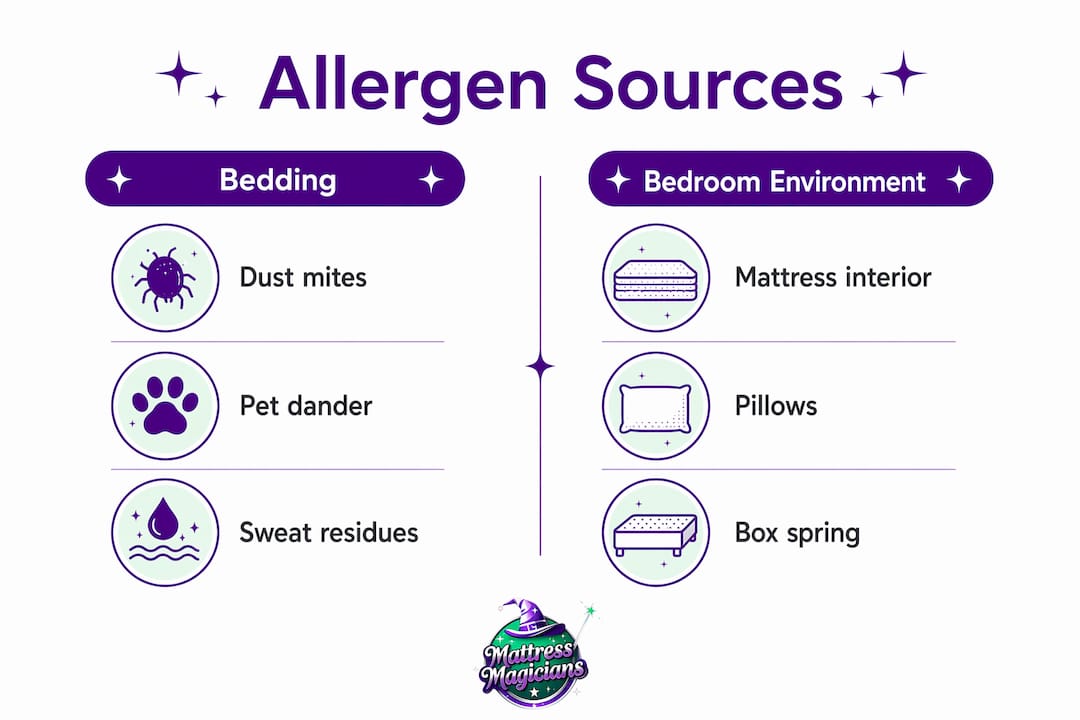
Pet dander compounds the problem even in homes where pets are kept off the bed. Cat and dog allergens attach to clothing and hair, transferring passively to bedding. Once there, they behave like dust mite allergens: they accumulate in the fabric and resuspend with movement. For allergy sufferers in Minneapolis and across the Twin Cities, where people spend more time indoors during long winters, this indoor allergen load becomes the dominant exposure source for months at a time.
Why certified bedding matters for asthma and allergy sufferers
Not all bedding marketed as “hypoallergenic” delivers meaningful protection. Certification is what separates a real barrier from a marketing claim.
Allergen-impermeable, zippered encasements for mattresses, box springs, and pillows are the most evidence-backed intervention for reducing dust mite exposure. The Asthma and Allergy Foundation of America specifically recommends zippered allergen-resistant or plastic covers and states that encasing mattresses works better than air cleaners at reducing allergy symptoms. That comparison is worth pausing on: a certified mattress cover outperforms an air purifier for symptom control in clinical evidence.
What to look for in certified bedding:
- Allergen impermeability: The cover’s pore size must be small enough to block dust mite bodies and their fecal particles, which are the primary allergen source.
- VOC limits: Certifications such as OEKO-TEX Standard 100 test for harmful chemical residues and emissions from textile treatments and dyes.
- Washability: Covers must withstand repeated hot-water washing without degrading their barrier properties.
- Full encasement: Partial covers leave the mattress sides and bottom exposed, defeating the purpose.
Certification does not replace cleaning. A zippered cover stops new allergens from reaching the mattress interior, but it also needs regular washing to clear what accumulates on its own surface. Think of it as a filter that requires maintenance, not a one-time fix. For people managing asthma or allergic reactions to pet dander, certified encasements combined with a consistent washing routine form the foundation of bedroom allergen control.
How mattress chemical emissions affect the air you breathe at night
The allergen story gets a chemical layer on top of it. Mattresses, particularly those made with polyurethane foam, emit VOCs that concentrate in the sleep microenvironment overnight.
Body heat is the primary driver. Research on polyurethane mattresses tested eight mattress types under simulated sleeping conditions and found that VOC emissions increased significantly when temperature and humidity rose to match a sleeping person’s body heat. Elevated temperature was the dominant factor, outweighing the effects of increased humidity and CO2 concentration. The study identified 18 VOCs with emission fluxes ranging from 10⁻⁴ to 10⁻¹ mg/(h·m²), and estimated that exposure levels for sleeping children could reach concerning concentrations for several compounds.
The breathing zone dependency makes this worse than it sounds. Because your face is close to the mattress surface, the air exchange rate between your immediate breathing zone and the broader bedroom air determines how much of that chemical load you actually inhale. Poor bedroom ventilation, a common condition in tightly sealed Minnesota homes during winter, keeps that concentration high.
Key finding: A 2024 analysis of over 3,400 participants found that higher mixed VOC exposure is positively associated with poor sleep patterns and chronic trouble sleeping, based on NHANES data.
Common mattress materials and their emission profiles differ meaningfully:
- Polyurethane foam: Highest VOC emitter; off-gasses compounds including toluene, benzene derivatives, and formaldehyde-related chemicals.
- Memory foam: A variant of polyurethane with similar emission concerns, often combined with chemical flame retardants.
- Latex (natural): Lower synthetic chemical load, but can still emit terpene-based compounds and carries allergen risk for latex-sensitive individuals.
- Innerspring with foam layers: Emission profile depends on the foam type used in comfort layers.
For families concerned about VOC exposure from mattresses, the practical response is better ventilation, certified low-emission covers, and periodic professional cleaning to remove chemical residue that accumulates on the mattress surface over time.
Practical strategies to improve air quality through bedding care
Bedding hygiene is not complicated, but most people do it wrong in at least one critical way.
Washing frequency and temperature
Weekly washing is the clinical standard for dust mite control. The water needs to be hot enough to kill mites, and typical home wash cycles often fall short of the threshold required for effective sanitization. Drying on a high-heat dryer cycle after washing adds a second kill step. Pillowcases and sheets should be washed every week; duvet covers and blankets every two weeks at minimum.
Allergen-impermeable covers
Zippered encasements on the mattress, box spring, and pillows block the primary allergen reservoir from direct contact with the sleeper. Wash the encasements themselves monthly. Replace them if the zipper fails or the fabric shows wear, since a compromised cover provides no barrier.
Airing and ventilation
Pulling back the covers after waking and letting the mattress surface air out for 20–30 minutes reduces the humidity that dust mites need to survive. Opening a window when outdoor air quality permits improves the air exchange rate in the bedroom, diluting both VOCs and resuspended particles. For signs that bedroom air quality has already deteriorated, morning congestion, persistent odors, and worsening allergy symptoms overnight are the most common indicators.
Material selection
Tightly woven natural fabrics like cotton and linen tend to accumulate fewer allergens than loosely woven synthetics, and they wash more effectively at high temperatures. For the mattress itself, research shows that open-structure materials resuspend fewer fine particles than memory foam or latex under repeated body movement.
Pro Tip: Pair a certified allergen-impermeable mattress cover with a HEPA-filter vacuum on the mattress surface every month before washing the cover. This removes the surface layer of accumulated particles before you seal them back in.
When DIY is not enough
Surface washing and vacuuming do not reach the interior of a mattress. Allergens, sweat residue, and chemical buildup accumulate in the foam layers over years of use, well beyond what any home method can address. Professional deep cleaning is the only way to extract that interior contamination and reset the mattress to a genuinely clean baseline.
Professional mattress cleaning and its role in better bedroom air quality
There is a gap between a mattress that looks clean and one that actually is. Most people never close it.
Professional mattress cleaning goes beyond surface treatment. Deep sanitization methods extract allergens, dust mites, sweat residue, and chemical buildup from inside the foam layers, not just from the surface fabric. For households managing asthma or allergy triggers, this distinction is the difference between symptom management and symptom reduction. The mattress sanitization process targets the biological and chemical load that accumulates invisibly over years of use.
Persistent odors are another indicator that DIY methods have reached their limit. Sweat, pet accidents, and biological residue soak into foam layers where no surface spray can follow. Professional treatment addresses the source, not the symptom. The same applies to chemical residue from foam off-gassing: professional cleaning removes the surface accumulation that concentrates VOC emissions over time.
For Twin Cities residents, this is particularly relevant. Minneapolis and St. Paul homes stay sealed for long stretches during winter, limiting the natural ventilation that would otherwise dilute indoor pollutants. That means allergens and VOCs build up faster and stay concentrated longer than in climates with year-round open-window ventilation. A mattress that might be manageable in a well-ventilated home becomes a more serious air quality issue in a Minnesota winter bedroom.
Mattressmagicians serves homeowners, renters, and allergy sufferers across the Twin Cities metro, including Minneapolis, St. Paul, and Woodbury, with professional mattress cleaning and sanitization that reaches what home methods cannot. The service is designed for people who have already tried the DIY route and want a result that actually holds.
Your next step toward a cleaner sleep environment
If you have been waking up congested, dealing with allergy flare-ups at night, or noticing that your mattress has accumulated years of use without a professional clean, the bedding is the place to start.
Mattressmagicians offers on-demand, mobile mattress cleaning and sanitization across the Twin Cities, with no hauling, no replacement cost, and no guesswork about whether the job was done right. The service targets the interior allergen and chemical load that washing and vacuuming leave behind, which is exactly what drives poor bedroom air quality for most households. Whether you are managing allergies, preparing a guest room, or simply overdue for a deep clean, professional mattress cleaning is the most direct path from a contaminated sleep surface to a genuinely healthy one. Book your service at mattressmagicians.com and wake up to a measurable difference.
Key Takeaways
Bedding is the single largest contributor to poor indoor air quality in the bedroom, and managing it requires both the right materials and consistent professional care.
| Point | Details |
|---|---|
| Bedding drives allergen exposure | Over 90% of U.S. bedrooms contain multiple detectable allergens, with bedding as the primary reservoir. Over 73% have elevated levels such as dust mites and pet dander. |
| Movement resuspends particles | Body movements during sleep push settled allergens and fine particles directly into the breathing zone. |
| Heat amplifies VOC emissions | Body heat during sleep significantly increases VOC off-gassing from polyurethane mattress foams. |
| Certified covers outperform air cleaners | Zippered allergen-impermeable encasements reduce dust mite exposure more effectively than air purifiers for symptom control. |
| Mattressmagicians addresses the interior | Professional cleaning by Mattressmagicians removes deep-seated allergens and chemical residue that home methods cannot reach. |
FAQ
What is the most common cause of poor indoor air quality in bedrooms?
Dust mites and their waste particles in bedding are the leading cause, followed by pet dander and VOCs from mattress foams. Research shows over 90% of U.S. bedrooms contain multiple detectable allergens, with over 73% having elevated levels such as dust mites and pet dander.
Why does indoor air quality get worse at night?
Body heat and humidity during sleep increase VOC emissions from mattress materials, while body movements resuspend settled allergens directly into the breathing zone. Poor bedroom ventilation keeps those concentrations elevated throughout the night.
How can you tell if your bedroom has poor indoor air quality?
Morning congestion, worsening allergy or asthma symptoms overnight, persistent mattress odors, and frequent nighttime waking are the most common signs. A mattress that has never been professionally cleaned is a strong indicator of accumulated allergen load.
What is the primary reason for airing out bedding?
Airing reduces the warmth and humidity that dust mites need to survive and thrive. Pulling back covers after waking lets moisture from sweat evaporate, cutting the conditions that support mite populations in the mattress and pillow layers.
How often should bedding be professionally cleaned?
Most households benefit from professional mattress cleaning once or twice a year, with more frequent service for allergy sufferers, pet owners, or households with young children. Mattressmagicians provides mattress sanitization that targets the interior contamination washing alone cannot address.

