
TL;DR:
- Most Twin Cities mattress maintenance involves monthly vacuuming, quarterly rotation and deodorizing, and annual professional cleaning. Timely spot treatments are essential after spills or accidents, with professional services necessary if odor persists or if contamination reaches the foam core. Proper scheduling, along with a quality waterproof protector, extends mattress lifespan and ensures sleep health in Minnesota’s varying climate.
Most Twin Cities homes do best on this cadence: quick monthly checks, a bundled quarterly refresh, and a professional deep clean every 12–24 months (sooner if you have pets, allergies, or a high-turnover rental). If something spills or a child has an accident, that moves the timeline up immediately.
Two things to know right now:
- Homeowners: vacuum monthly, rotate quarterly, wash your protector regularly, and spot-treat spills the same day they happen.
- Call a pro: when odor persists after spot treatment, when urine has soaked into the foam core, when you’re prepping a rental between guests, or when it’s been more than a year since the last deep clean.
Mattressmagicians serves Minneapolis, St. Paul, Woodbury, and the surrounding metro on demand. You can book a one-time deep clean or set up a recurring maintenance plan.
Pro Tip: A waterproof mattress protector is the single highest-return investment in mattress longevity. It keeps the cleaning cadence manageable and protects your warranty.
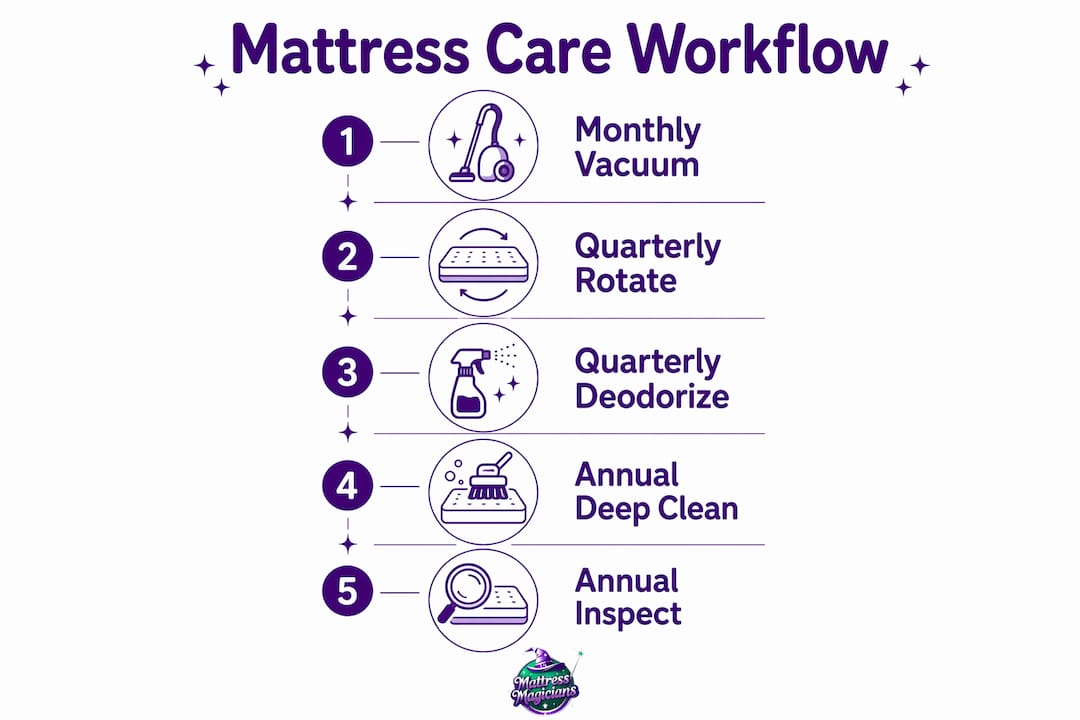
Table of Contents
- What does a practical Twin Cities mattress-care calendar look like?
- How does the professional on-site cleaning process actually work?
- What should you do immediately after a stain or urine accident?
- How does Twin Cities climate affect your mattress care schedule?
- How long does a mattress take to dry, and when is it safe to sleep on?
- What does professional mattress cleaning cost, and when should you replace instead?
- How do Airbnb hosts and property managers run a fast, repeatable turnover?
- What can you safely do between professional visits?
- Which professional cleaning method is right for your mattress?
- How do you verify a pro’s claims before you book?
- Key Takeaways
- The workflow that actually works in Minnesota
- Mattressmagicians serves the Twin Cities with on-demand professional cleaning
- Useful sources
- FAQ
What does a practical Twin Cities mattress-care calendar look like?
A calendar you’ll actually follow beats a perfect one you won’t. The goal here is to bundle tasks so they feel like one 15-minute routine rather than four separate chores.
Monthly tasks
- Strip bedding and vacuum the mattress surface and sides with an upholstery attachment.
- Inspect the protector for tears, staining, or compression. Wash it if it’s been more than two weeks.
- Wash sheets and pillowcases weekly; duvet covers every two to four weeks.
- Spot-check for new stains or odor. Treat immediately if found.
Quarterly tasks
Bundling rotation with vacuuming, deodorizing, and inspection on a quarterly cadence makes the whole system predictable and manageable. Rotate head-to-foot, then vacuum, then sprinkle baking soda, let it sit for a few hours, and vacuum again. Finish with a visual inspection of the foundation and frame.
| Season | Primary Task | Secondary Task | Notes |
|---|---|---|---|
| Spring | Rotate + vacuum | Air out mattress | Open windows; lower humidity helps |
| Summer | Air out + inspect | Deodorize | Higher humidity; watch for moisture |
| Fall | Deodorize + inspect | Wash protector | Pre-winter allergen reset |
| Winter | Inspect foundation | Vacuum | Dry indoor air; static and dust build |
Annual tasks
Schedule a professional sanitization or deep clean once per year at minimum. Check the mattress for body impressions deeper than 1.5 inches, which signals structural failure rather than a hygiene problem. Inspect slat spacing on your foundation: gaps wider than 3 inches accelerate core failure regardless of how well you clean.
A properly maintained mattress, with regular rotation and a quality protector, can last several years longer than typical bed lifespans observed with neglected beds.
Pro Tip: Set a recurring phone reminder on the first day of each new season. Pair it with a sheet wash so the mattress is already bare when the reminder fires.
How does the professional on-site cleaning process actually work?
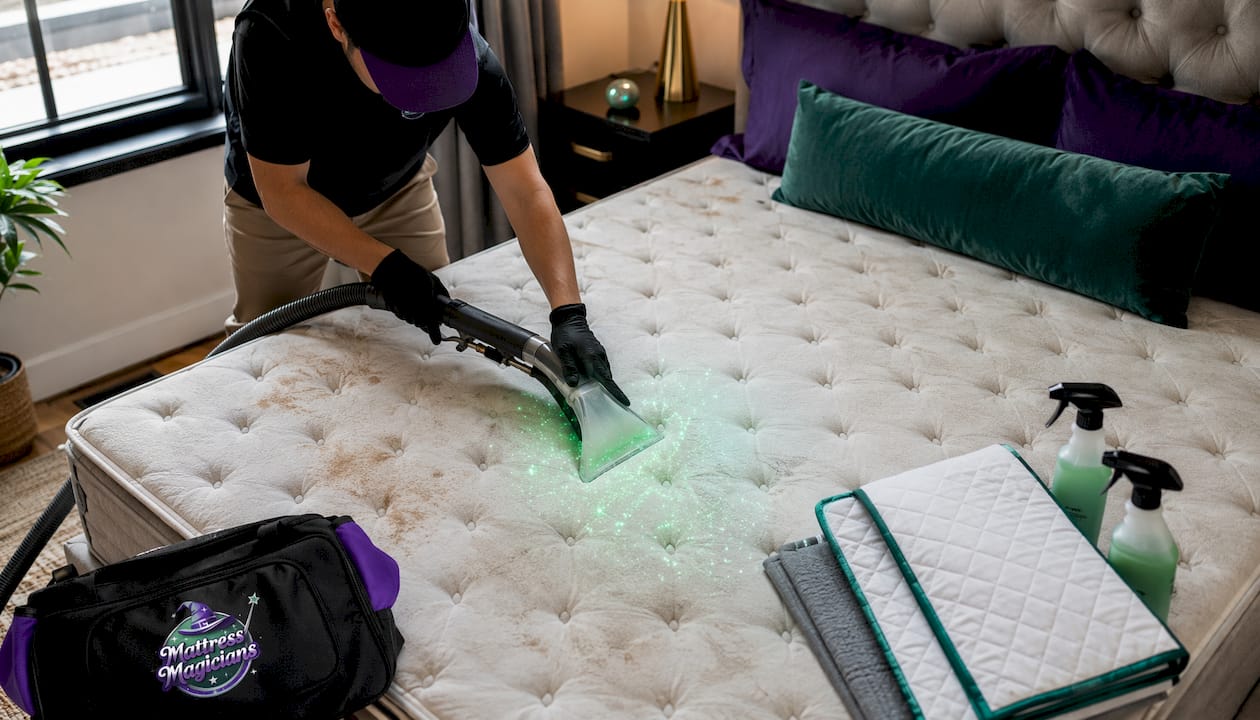
When a Mattressmagicians technician arrives, the job follows a consistent sequence: inspect, protect, pre-treat, clean, extract, sanitize, deodorize, dry, and document. The whole process typically runs 45–90 minutes of active work, depending on mattress size and soil level.
Step-by-step:
- Intake and inspection. The technician examines the surface for stains, odor zones, impression depth, and fabric condition. This determines which method and pre-treatments are appropriate.
- Protective measures. Floor and furniture protection goes down before any equipment is deployed.
- Pre-treatment. Enzyme-based solutions are applied to biological stains (urine, sweat, blood) and allowed to dwell. Dwell time is typically 10–15 minutes.
- Primary cleaning method. Depending on mattress type and soil level, the technician selects dry extraction, hot-water extraction, or a carbonated method (details in the method comparison section below).
- HEPA-sealed extraction. Professional-grade HEPA-sealed suction removes particles down to 0.3 microns, including dust mite waste and mold spores that a household vacuum cannot capture.
- UVC sanitization pass. A UVC light pass reduces surface bacteria and mold spores without chemicals.
- Deodorizing. A non-toxic antibacterial deodorizer is applied and allowed to set.
- Drying. Fans accelerate drying. Dry methods are ready same-day; hot-water extraction requires 8–24 hours.
- Final inspection and documentation. Before-and-after photos, a written condition report, and a service summary are provided.
A mattress that looks clean on the surface can still harbor embedded allergens, mold spores, and biological waste that no household vacuum reaches. Professional HEPA-sealed extraction is the only method that reliably removes contaminants at the microscopic level — which is exactly why the results feel different the first night after a professional clean.
Pro Tip: Ask your technician to show you the before-and-after photos before they leave. A reputable company documents every job.
What should you do immediately after a stain or urine accident?
Speed matters more than technique here. The first 30 minutes determine whether a stain sets into the foam or stays manageable.
Immediate homeowner steps:
- Strip all bedding immediately.
- Blot from the outside edge inward with a clean, dry cloth. Never rub.
- Apply cold water sparingly to dilute the stain. Avoid saturating the foam.
- Press a dry towel firmly onto the area and hold for 30–60 seconds to absorb moisture.
- Apply an enzyme cleaner (available at most hardware stores) and let it dwell for at least 15 minutes before blotting again.
- Prop the mattress on its side or use fans to air-dry for a minimum of 8 hours before replacing bedding.
When to stop DIY and call a pro:
- Urine has soaked through to the foam core (you can tell by the volume and the smell persisting after drying).
- The stain is old or set.
- You smell mold or mildew after drying.
- Multiple accidents have occurred in the same area.
- You’re managing a rental property and need documented evidence of remediation.
| Approach | Effectiveness | Risk |
|---|---|---|
| DIY blot + enzyme cleaner | Good for fresh, surface-level spills | Saturation can push fluid deeper into foam |
| DIY steam cleaner | Moderate surface sanitization | Damages memory foam; can spread contamination |
| Professional enzyme + extraction | High; reaches foam core | Requires drying time (8–24 hrs for wet methods) |
| Professional dry method | High; same-day readiness | Less effective on very deep saturation |
For heavy contamination or persistent odor, Mattressmagicians offers dedicated stain and urine removal service with enzyme pre-treatment and HEPA extraction.
Pro Tip: Never use bleach on a mattress. It degrades foam, sets protein stains, and leaves a residue that irritates skin.
How does Twin Cities climate affect your mattress care schedule?
Minnesota’s climate creates two distinct challenges: humid summers that slow drying and raise mold risk, and dry winters where static and dust accumulate faster than most people expect.
Seasonal impacts to know:
- Summer (June–August): Relative humidity in the Twin Cities regularly climbs above 70%. After any wet cleaning method, drying times extend. Schedule professional visits for early morning so the mattress has the full day to dry with windows open and AC running.
- Fall (September–October): The transition period is ideal for a deep clean. Humidity drops, windows can be open, and you’re resetting before the heating season.
- Winter (November–March): Indoor forced-air heating drops relative humidity significantly. Dust and skin particles accumulate faster, and static electricity holds them in fabric fibers. Monthly vacuuming becomes more important, not less.
- Spring (April–May): Allergen season. Pollen enters through windows, and dust mite populations spike with warming temperatures. This is the best time to schedule a professional allergen-reduction treatment.
Dr. Alanna Hare notes that removing sweat and skin particles reduces nighttime overheating and airway irritation — a point that matters especially in climates with pronounced seasonal humidity swings like Minnesota’s.
Pro Tip: Run a dehumidifier or your central AC during and after any wet cleaning in summer months. Target indoor humidity below 50% to cut drying time in half and eliminate mold risk.
How long does a mattress take to dry, and when is it safe to sleep on?
The answer depends almost entirely on which cleaning method was used.
Drying timelines by method:
- Dry methods (vibration, HEPA extraction, UVC, antibacterial finish): same-day readiness, typically 1–2 hours after service.
- Carbonated or dry-foam methods: 2–4 hours in a well-ventilated room.
- Hot-water extraction: 8–24 hours depending on room humidity, airflow, and how much solution was used. In a humid Twin Cities summer, plan for the longer end.
Do not sleep on a damp mattress. Moisture trapped inside foam creates ideal conditions for mold and mildew growth, and the smell that follows is very difficult to remove without a full professional remediation. Memory foam and latex hold moisture longer than innerspring mattresses, so the risk is higher with those materials.
Fast-dry tips:
- Point a box fan directly at the mattress surface.
- Run the AC or a dehumidifier in the room.
- Prop the mattress at an angle if possible to expose the underside.
- Keep the bedroom door open for cross-ventilation.
Pro Tip: If a technician tells you a hot-water extraction job is ready to sleep on in two hours, ask how. In normal Twin Cities indoor conditions, that timeline is not realistic for foam mattresses.
What does professional mattress cleaning cost, and when should you replace instead?
Pricing for professional mattress cleaning in the Twin Cities varies based on mattress size, soil level, and which services are included. Single-mattress cleans generally run less than multi-mattress visits, which often come with a per-unit discount. Sanitization add-ons, stain surcharges, and urine remediation each add to the base price. The best way to get an accurate number is to request an on-site or phone estimate that accounts for your specific situation.
| Service | Typical Variables |
|---|---|
| Single mattress deep clean | Size, soil level, method used |
| Multi-mattress visit | Per-unit discount applies |
| Sanitization add-on | Allergen level, UVC pass included |
| Stain/urine surcharge | Age of stain, saturation depth |
When to clean vs. replace
Deep cleaning addresses biological contaminants, odors, and surface stains. It cannot fix structural failure. Use this checklist:
Replace if:
- Body impressions are deeper than 1.5 inches (the threshold where core support is gone).
- The mattress sags visibly when no one is on it.
- You wake up with back or hip pain that disappears when you sleep elsewhere.
- Visible mold is present inside the mattress layers.
- The mattress has been in service for more than 10 years with heavy use.
- Repeated repairs or warranty claims have already been made.
Clean if:
- Odor, staining, or allergen buildup is the primary complaint.
- The mattress is structurally sound but hygienically compromised.
- You’re preparing a rental property between tenants.
- You want to extend a mattress’s useful life before a planned replacement.
A professional clean on a structurally sound mattress is almost always a better investment than early replacement. On average, a well-maintained mattress lasts 7–10 years; a neglected one rarely makes it past five.
Pro Tip: Check your mattress warranty before booking anything. Many manufacturers cover sagging beyond 1.5 inches — a professional condition report from a cleaning visit can serve as supporting documentation for a warranty claim.
How do Airbnb hosts and property managers run a fast, repeatable turnover?
High-turnover properties need a workflow that takes minutes, not hours, and leaves a paper trail. Here’s the sequence Mattressmagicians recommends for rental operators in the Twin Cities.
Turnover checklist (every guest change):
- Remove and inspect the mattress protector. Replace if stained or compromised; wash immediately.
- Visually inspect the mattress surface for new stains, odor, or damage.
- Photograph any findings with a timestamp before cleaning.
- Apply a quick surface sanitization spray (non-toxic, fast-drying) and allow to dry.
- Spot-treat any new stains with an enzyme cleaner before they set.
- Replace with a fresh, laundered protector.
- Log the date, unit number, and condition in your service record.
Scheduled deep cleans:
- Every 3–6 months for high-occupancy short-term rentals.
- After any guest who reports an illness, pet, or accident.
- Before listing a unit after a long-term tenant vacates.
For multifamily buildings and apartment operators, coordinating on-site mattress cleaning across multiple units is easier when you batch visits. Mattressmagicians can schedule multi-unit visits to minimize disruption. Property managers handling package logistics and daily operations may also find value in coordinating with services like daily package room management to keep turnover operations running smoothly.
Escalation protocol:
- If urine saturation is suspected, do not simply cover it. Book a professional remediation before the next guest checks in. Document the service for your records in case of a guest dispute.
- Persistent odor after spot treatment is a signal that contamination has reached the foam core.
Pro Tip: Keep a laminated turnover checklist in each unit’s cleaning closet. Consistency across staff members is what prevents missed escalations.
What can you safely do between professional visits?
Monthly maintenance between professional visits is straightforward. The goal is to slow contamination buildup, not eliminate the need for professional cleaning entirely.
Do list:
- Vacuum the mattress surface and sides monthly with an upholstery attachment.
- Wash your mattress protector every two to four weeks, or immediately after any spill.
- Rotate the mattress head-to-foot every three months.
- Spot-treat fresh spills the same day using cold water and an enzyme cleaner.
- Sprinkle baking soda on the surface quarterly, let it sit for a few hours, then vacuum it up to absorb odors.
- Air the mattress out by removing bedding and opening windows when weather allows.
Don’t list:
- Don’t use a steam cleaner on memory foam or latex. Steam can damage foam density and void your warranty.
- Don’t saturate foam with water during spot cleaning. Moisture that reaches the core is very difficult to dry safely.
- Don’t use bleach, ammonia, or abrasive cleaners on any mattress surface.
- Don’t flip a single-sided mattress. Most modern mattresses are designed for rotation only, not flipping.
- Don’t skip the protector. Monthly vacuuming and a breathable, washable protector significantly reduce allergen and moisture accumulation between professional visits.
| Task | Safe for Memory Foam | Safe for Innerspring | Safe for Latex |
|---|---|---|---|
| Upholstery vacuum | Yes | Yes | Yes |
| Baking soda deodorize | Yes | Yes | Yes |
| Enzyme spot cleaner | Yes (blot only) | Yes | Yes (blot only) |
| Steam cleaner | No | With caution | No |
| Wet saturation | No | Limited | No |
For allergen-specific maintenance, Mattressmagicians has a detailed allergen removal workflow that goes beyond what monthly vacuuming can accomplish.
Which professional cleaning method is right for your mattress?
Not every method suits every mattress or every situation. Here’s how the main options compare.
| Method | Best For | Drying Time | Foam/Latex Safe | Allergen Capture |
|---|---|---|---|---|
| Hot-water extraction | Heavy soil, deep stains | 8–24 hours | Use with caution | High with HEPA |
| Carbonated/dry-foam | Moderate soil, fast turnaround | 2–4 hours | Yes | Moderate |
| Dry extraction (vibration + HEPA) | Allergen removal, same-day | 1–2 hours | Yes | Highest |
| UVC sanitization | Bacteria, mold spores | Immediate | Yes | Moderate |
Key tradeoffs:
- Hot-water extraction delivers the deepest clean for heavily soiled mattresses but carries real moisture risk for foam. In a humid Twin Cities summer, drying can stretch past 24 hours without fans and AC running.
- Dry methods using vibration, HEPA-sealed extraction, and a UVC pass offer same-day readiness without wetting the mattress. This is the right choice for memory foam, latex, and any situation where the mattress needs to be usable that evening.
- HEPA-sealed extraction is the only method that reliably captures particles down to 0.3 microns, which is necessary to remove dust mite excrement and mold spores embedded in mattress layers. A standard household vacuum does not come close to this level of filtration.
- UVC sanitization adds a chemical-free antibacterial layer that works well as a standalone treatment between deep cleans or as an add-on to any method.
For allergy sufferers in the Twin Cities, the combination of HEPA extraction and UVC sanitization is the most effective option available. Mattressmagicians offers mattress sanitization as a standalone service or bundled with a full deep clean.
How do you verify a pro’s claims before you book?
A trustworthy mattress cleaning company will answer every question below without hesitation. If a technician gets vague or defensive, that’s your answer.
Questions to ask before booking:
- What is your step-by-step on-site workflow? Can you walk me through it?
- What filtration specs does your extraction equipment use? (Look for HEPA-sealed or equivalent.)
- Are you insured and registered as a local business in Minnesota?
- Do you provide before-and-after photos and a written condition report?
- What enzyme or chemical products do you use, and are they safe for children and pets?
- What is your drying time estimate for my mattress type and method?
- What does your service guarantee cover, and for how long?
What acceptable answers look like:
- A clear, step-by-step workflow description (not a vague “we deep clean”).
- HEPA filtration confirmation with a particle-size spec (0.3 microns is the standard).
- Proof of local business registration and liability insurance on request.
- A commitment to before-and-after photos as standard practice.
- Named products with safety data sheets available.
- A realistic drying window that matches the method (same-day for dry; 8–24 hours for wet).
- A written service guarantee with a clear re-service or refund policy.
Documentation a reputable company provides:
- Timestamped before-and-after photos.
- A written condition report noting stains, impressions, and any concerns.
- A service summary listing methods and products used.
- A sanitation statement if UVC or antibacterial treatments were applied.
For rental operators, this documentation is also your protection against guest disputes. A post-tenant mattress refresh with proper documentation creates a clear record of condition at each turnover.
Key Takeaways
A consistent Twin Cities mattress care workflow, combining monthly DIY maintenance, quarterly bundled tasks, and annual professional cleaning, is the most reliable way to extend mattress life and protect sleep health.
| Point | Details |
|---|---|
| Follow a seasonal cadence | Monthly vacuuming, quarterly rotation and deodorizing, annual professional deep clean. |
| Climate matters in Minnesota | Schedule wet cleaning in fall or spring; use fans and AC to hit safe drying times in summer. |
| Clean vs. replace threshold | Impressions deeper than 1.5 inches signal structural failure; cleaning won’t fix that. |
| Dry methods for same-day use | HEPA dry extraction and UVC sanitization leave mattresses ready in 1–2 hours. |
| Mattressmagicians for local service | On-demand and scheduled professional cleaning across Minneapolis, St. Paul, and the Twin Cities metro. |
Pro Tip: Book your annual professional clean in September or October. Fall is the ideal window in the Twin Cities: humidity is dropping, windows can be open, and you’re resetting before the long heating season.
The workflow that actually works in Minnesota
There’s a version of mattress care advice that sounds thorough on paper but falls apart the moment you factor in a Minnesota winter, a humid July, or a rental unit that turns over every three days. Generic guides don’t account for any of that.
What actually works here is a system built around the climate and the use case. For homeowners, that means bundling tasks so they happen automatically with the seasons rather than requiring a separate decision each time. For Airbnb hosts and property managers, it means a fast, documented turnover protocol that protects you legally and keeps guests comfortable.
The clean-versus-replace question is where most people get it wrong. They either replace too early because a mattress looks dirty, or they keep cleaning a mattress that has already failed structurally. The 1.5-inch impression threshold is the clearest line in the industry: below it, a professional clean is almost always the better investment; above it, no amount of cleaning restores support.
One thing that’s underappreciated: the protector. It’s not glamorous, but a quality waterproof encasement changes the entire economics of mattress ownership. It keeps the cleaning cadence manageable, it protects your warranty, and it means a spill at 2 AM is a laundry problem rather than a restoration project.
Mattressmagicians serves the Twin Cities with on-demand professional cleaning
Dirty mattresses don’t wait for a convenient time. Mattressmagicians brings professional-grade cleaning directly to homes, rentals, and commercial properties across Minneapolis, St. Paul, Woodbury, and the surrounding metro, without the hassle of hauling anything anywhere.
Core services include deep cleaning, mattress sanitization, stain and urine removal, odor elimination, allergen reduction, and recurring maintenance plans for residential and commercial customers. Same-week availability is standard for most Twin Cities locations.
Scheduling is straightforward: contact Mattressmagicians to describe your situation, get a clear estimate, and confirm a time window. On-site visits typically run 45–90 minutes. For multi-unit properties, batch scheduling is available to minimize disruption.
Book your professional mattress cleaning at mattressmagicians.com, or check availability for same-week service in Minneapolis.
Useful sources
Authoritative references used throughout this article:
- Sleep Foundation: Mattress Care — Rotation schedules, protector guidance, and cleaning frequency recommendations from a leading sleep health organization.
- Sleep Foundation: How Long Should a Mattress Last — Lifespan data by mattress type and replacement decision criteria.
- National Mattress Authority: Mattress Care and Maintenance — Cleaning limits, structural failure thresholds, and protector investment guidance.
- Pureairo: Deep-Clean Your Mattress — HEPA filtration specs, dry method workflow, and allergen removal science.
- Mattress Miracle: How Often Should You Turn Your Mattress — Quarterly care calendar and bundled task system.
- BedMart: How to Sanitize a Mattress — Immediate spill response protocol and drying guidance.
- Daily Mail: Expert Mattress Cleaning Methods — Sleep physician guidance on sweat, skin particles, and sleep quality.
- Metapress: Why Regular Mattress Cleaning Is Essential — Monthly maintenance habits and allergen accumulation data.
- Mattressmagicians: Allergen Removal Workflow — Local Twin Cities guidance on allergy-focused mattress care.
FAQ
What is a step-by-step plan for mattress cleaning?
Strip bedding, vacuum the surface and sides with an upholstery attachment, spot-treat stains with an enzyme cleaner, apply baking soda for odor absorption, let it sit for a few hours, then vacuum again. For deep contamination or allergen removal, a professional service with HEPA-sealed extraction is more effective than any DIY method.
How much does professional mattress cleaning cost in the Twin Cities?
Pricing varies by mattress size, soil level, and services included; stain and urine surcharges apply for heavy contamination. Contact Mattressmagicians for an estimate specific to your mattress and situation.
How long should a $2,000 mattress last?
A well-maintained mattress typically lasts 7–10 years; without regular rotation, a quality protector, and periodic professional cleaning, that lifespan can drop closer to five years. Structural failure, indicated by body impressions deeper than 1.5 inches, is the clearest sign it’s time to replace regardless of age.
How long before a mattress is safe to sleep on after professional cleaning?
Dry methods (HEPA extraction, UVC sanitization) leave a mattress ready in 1–2 hours. Hot-water extraction requires 8–24 hours of drying time, longer in humid summer conditions. Never sleep on a damp mattress; trapped moisture creates mold risk, especially in foam and latex.
Do I really need to wait 72 hours for a new mattress to inflate?
That guideline about waiting applies to compressed foam mattresses shipped in a box, not to professionally cleaned mattresses. After cleaning, the relevant wait time depends on the drying window for the method used, not an inflation period.

