
TL;DR:
- Poor bedroom air quality involves elevated pollutants, allergens, or stale air that harm health and disrupt sleep. Waking with headaches, congestion, or odors indicates poor air exchange, mold, or off-gassing from mattresses. Regular cleaning, ventilation, and mattress maintenance can significantly improve indoor air and overall health.
Poor bedroom air quality is defined as indoor air conditions that contain elevated levels of pollutants, allergens, or stale air sufficient to affect your health, comfort, or sleep. The American Lung Association and the EPA both recognize that indoor pollutant levels can run 2 to 5 times higher than outdoor levels. That gap matters most in the bedroom, where you spend roughly a third of your life breathing the same air. If you wake up with a headache, notice a musty smell, or feel congested every morning, your bedroom air is likely the cause, not a cold.
Signs of poor bedroom air quality you should never ignore
Recognizing the specific signs of poor bedroom air quality is the fastest way to act before symptoms become chronic. These indicators fall into three categories: physical symptoms, visible clues, and air characteristics.
1. Morning headaches that clear after you leave the room
Waking up with a headache that fades within an hour of getting up is a reliable signal of overnight air quality problems. CO2 buildup overnight in closed bedrooms regularly pushes concentrations above 1,500 ppm, a level associated with cognitive dullness and head pain. Fresh outdoor air averages around 420 ppm. That difference explains why the headache disappears once you open a window or step outside.
2. Persistent nasal congestion or scratchy throat upon waking
Nasal congestion and a scratchy throat that appear every morning and resolve by midday point directly to bedroom air contaminants. Early warning signs like these are frequently mistaken for seasonal allergies or a recurring cold, which delays any real fix. The bedroom environment, not the season, is usually the culprit.
3. A stale, musty, or chemical odor in the room
A room that smells stale when you first walk in after sleeping has poor air exchange. A musty odor specifically signals mold or mildew growth, often hidden behind walls, under carpet, or inside the mattress itself. A chemical smell, sometimes described as “new furniture” or “plastic,” indicates volatile organic compounds off-gassing from mattresses, bedding, or furniture finishes. Mattresses emit VOCs that increase with the heat and humidity generated during sleep, making the overnight period the peak exposure window.
Pro Tip: Open your bedroom door and window for 10 minutes each morning. If the odor clears quickly, the problem is ventilation. If it lingers, the source is likely the mattress or a mold colony.
4. Excessive dust accumulation on surfaces
Dust that reappears on nightstands and shelves within days of cleaning signals a high particle load in the air. Bedroom dust contains a concentrated mix of skin cells, dust mite waste, pet dander, and fabric fibers. Allergen reservoirs in mattresses and pillows continuously shed particles into the air, especially when disturbed. Rapid dust return means your air is saturated with particulates your HVAC filter is not capturing.
5. Visible mold or mildew spots
Black, green, or gray spots on walls, window frames, or ceiling corners are direct evidence of a moisture problem driving poor indoor air quality. Mold releases spores continuously, and those spores are among the most potent bedroom air contaminants known to trigger asthma attacks. Mold behind a headboard or under a mattress is common in Minnesota homes during winter, when condensation builds on cold exterior walls.
6. Condensation on windows each morning
Condensation on bedroom windows indicates that indoor humidity is too high relative to the cold glass surface. High humidity accelerates mold growth, increases dust mite populations, and causes VOCs to off-gas from materials at a faster rate. Relative humidity above 50% in a bedroom creates conditions where dust mite allergens thrive and mold colonies establish quickly.
7. Worsening allergy or asthma symptoms at night
If your allergy or asthma symptoms peak between bedtime and early morning, the bedroom is the source. Bed-making and movement during sleep trigger particle bursts that temporarily spike airborne dust, pet dander, and skin cells. People who suffer from allergies feel the worst effect in the first hour after lying down, precisely because disturbing bedding launches a cloud of settled allergens.
8. Fatigue that sleep does not fix
Waking up tired after a full night of sleep is a symptom that indoor air quality research links directly to poor ventilation and elevated CO2. High CO2 reduces blood oxygen saturation during sleep, which fragments sleep architecture without fully waking you. The result is unrefreshing sleep that feels like insomnia but is actually a breathing environment problem.
9. Dry eyes or skin irritation upon waking
Dry, itchy eyes or irritated skin in the morning point to two possible causes: very low humidity drying out mucous membranes, or chemical irritants from off-gassing materials. Health effects from poor indoor air range from immediate irritation of the eyes, nose, and throat to longer-term respiratory and cardiovascular risks. Skin irritation that clears after showering and leaving the room confirms a bedroom-specific source.
10. Symptoms that resolve when you sleep elsewhere
The most definitive test for bedroom air quality problems requires no equipment at all. Sleeping in a different room and experiencing symptom relief confirms that the problem is localized to your bedroom’s microenvironment, not your general health. This single observation rules out systemic illness and points directly to the room as the source.
What causes poor bedroom air quality?
Understanding the root causes helps you target the right fix instead of guessing.
- Mattresses and bedding. VOCs off-gassed from mattresses increase overnight as body heat and humidity rise. Older mattresses also harbor years of accumulated dust mite waste, skin cells, and biological debris.
- Poor ventilation. Closed doors and windows trap CO2, humidity, and pollutants. Blocked door undercuts prevent air circulation even when the HVAC system is running.
- Moisture and mold. Bathrooms adjacent to bedrooms, humidifiers without proper maintenance, and cold exterior walls all create conditions for mold growth.
- Pet dander. Pets sleeping on or near the bed deposit dander directly into the mattress and bedding, where it becomes a persistent allergen source.
- Fragrances and cleaning chemicals. Air fresheners, scented candles, and spray cleaners release VOCs that accumulate in a closed bedroom overnight.
- Smoking. Tobacco smoke residue, known as thirdhand smoke, embeds in mattresses, curtains, and walls and continues releasing toxins long after the cigarette is gone.
Bedroom air quality often suffers even when the central HVAC system is excellent. Closed doors, blocked under-door airflow, and allergen accumulation in mattresses create a stagnant microenvironment that the whole-house system cannot reach. The bedroom behaves like a sealed chamber during sleep, concentrating every pollutant generated inside it.
How poor bedroom air quality impacts your health and sleep
The health consequences of breathing contaminated bedroom air range from annoying to serious, depending on exposure duration and individual sensitivity.
| Health Effect | Who Is Most at Risk | Typical Trigger |
|---|---|---|
| Morning headaches and fatigue | All adults | Elevated CO2 above 1,500 ppm |
| Respiratory irritation | Allergy and asthma sufferers | Dust mites, mold spores, VOCs |
| Asthma exacerbations | Children and adults with asthma | Mold spores, pet dander |
| Lasting lung development issues | Children under 12 | Chronic pollutant exposure |
| Eye and skin irritation | All occupants | Low humidity, chemical off-gassing |
Children’s developing lungs are especially vulnerable. Pollutants that cause minor discomfort in adults can cause lasting lung and heart health problems in children. A child sleeping in a bedroom with mold, high dust mite loads, or VOC-emitting materials faces compounding exposure every single night.
Sleep quality suffers measurably. Elevated CO2 fragments sleep architecture, reducing time spent in deep and REM sleep without triggering full waking. The result is a person who slept eight hours but feels exhausted, a pattern that is often mistaken for insomnia or stress rather than an air quality problem.
Pro Tip: If a child in your home snores, mouth-breathes during sleep, or wakes frequently, have the bedroom air quality assessed before assuming a medical cause. Allergen reduction alone resolves sleep-disordered breathing in many pediatric cases.
How to test and monitor your bedroom’s air quality
Diagnosing the problem accurately saves time and money compared to guessing.
- CO2 monitor. A CO2 monitor placed on the nightstand gives you overnight readings. Sustained levels above 1,200–1,500 ppm confirm inadequate ventilation and indicate you need better air exchange.
- Humidity gauge. A basic hygrometer shows whether bedroom humidity stays in the healthy 30–50% range. Readings above 50% create mold and dust mite risk.
- Visual inspection. Check window frames, baseboards, the underside of the mattress, and the wall behind the headboard for mold spots or water staining.
- Odor mapping. Walk into the bedroom after it has been closed for several hours. A strong odor on entry that fades after airing out points to poor ventilation. An odor that persists after airing out points to a physical source like a mattress or mold colony.
- The other-room test. Sleep in a different room for two nights. If symptoms resolve, the problem is definitively in the bedroom.
- Professional air quality assessment. When visual and sensory checks do not identify the source, a certified indoor air quality inspector can test for specific VOCs, mold spore counts, and particulate levels.
Effective strategies to improve bedroom air quality
Fixing bedroom air quality requires addressing both the sources and the airflow.
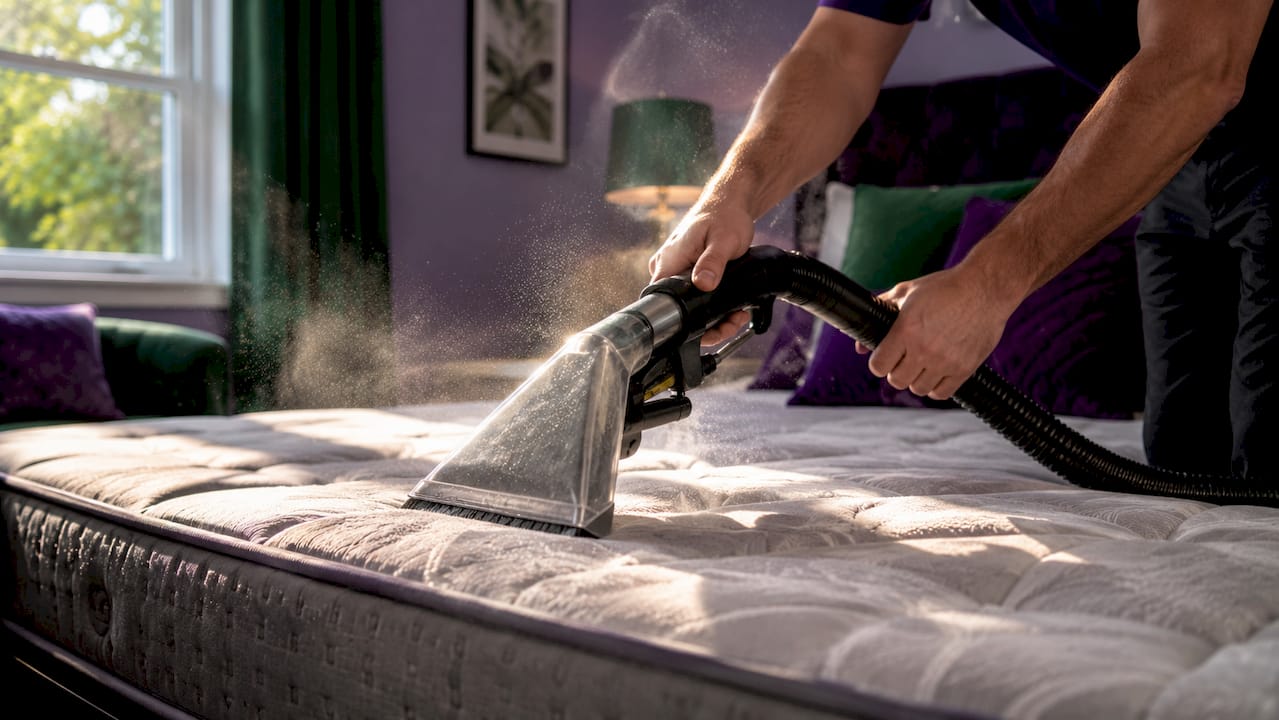
- Clean your mattress regularly. Proper mattress cleaning removes accumulated allergens, biological debris, and VOC-laden residue that standard vacuuming cannot reach. Professional cleaning is the most effective method for deep allergen and odor removal.
- Improve ventilation. Open windows for at least 10 minutes each morning. Use a box fan to pull fresh air in from one window and push stale air out from another. Adjust HVAC vents to ensure the bedroom receives adequate airflow.
- Control humidity. Run a dehumidifier if readings exceed 50%. Fix any plumbing leaks or condensation sources promptly. In dry Minnesota winters, a humidifier set to 40–45% prevents the opposite problem of overly dry air.
- Choose low-VOC products. Replace scented candles, plug-in air fresheners, and spray cleaners with fragrance-free alternatives. When buying new furniture or bedding, look for GREENGUARD Gold certification, which limits VOC emissions.
- Vacuum with a HEPA filter. Standard vacuum cleaners recirculate fine particles back into the air. A HEPA-equipped vacuum captures particles down to 0.3 microns, including dust mite waste and mold spores.
- Manage pet access. Keep pets off the bed if allergy symptoms are present. Wash pet bedding weekly and vacuum the mattress surface after any pet contact.
- Use an air purifier. A HEPA air purifier running overnight captures airborne particles continuously. Position it near the bed, not across the room, for maximum effect during sleep.
Key takeaways
Poor bedroom air quality causes measurable health harm, and the signs appear every morning if you know what to look for.
| Point | Details |
|---|---|
| Morning symptoms are the clearest signal | Headaches, congestion, and fatigue that clear after leaving the room confirm a bedroom air problem. |
| CO2 and VOCs peak overnight | Closed doors and mattress off-gassing combine to create the worst air quality of the day during sleep. |
| Mattresses are a primary pollutant source | Dust mites, allergens, and VOCs accumulate in mattresses and require professional cleaning to remove effectively. |
| Children face the highest risk | Developing lungs are more vulnerable to indoor pollutants, making bedroom air quality a pediatric health priority. |
| Ventilation and cleaning work together | Improving airflow reduces CO2 and humidity; cleaning the mattress removes the particle and chemical sources. |
Why the mattress is the most overlooked air quality problem in the bedroom
Most people think about ventilation, mold, or air purifiers when they hear “bedroom air quality.” The mattress rarely comes up. That is a significant blind spot, and I have seen it play out repeatedly in homes across the Twin Cities.
A mattress is a dense, warm, humid environment that collects everything: skin cells, sweat, dust mite colonies, pet dander, and chemical residue from cleaning products. It sits at the center of your breathing zone for eight hours every night. Every time you move, it releases a burst of particles directly into the air you inhale. No air purifier running across the room fully compensates for that.
What I find most striking is how often people replace air fresheners, buy new pillows, or run dehumidifiers without ever addressing the mattress. The mattress is the source, not the symptom. Professional cleaning, including allergen reduction treatment, removes what has built up over years in a way that surface vacuuming simply cannot replicate. Pairing that with better ventilation habits produces results that neither approach achieves alone.
If you have tried improving bedroom air quality and still wake up with symptoms, the mattress is almost certainly the missing piece.
— Phillip
Cleaner bedroom air starts with a cleaner mattress
If you have identified signs of poor bedroom air quality in your home, the mattress deserves your first attention. Mattressmagicians provides professional mattress cleaning and sanitization for homeowners and renters across Minneapolis, St. Paul, Woodbury, and the wider Twin Cities metro. Services include deep allergen extraction, dust mite treatment, VOC and odor removal, and stain treatment, all performed on-site without the hassle of hauling anything out.

When DIY vacuuming and air fresheners are not solving the problem, professional treatment removes what has accumulated over years inside the mattress. Book same-week service at mattressmagicians.com and wake up to noticeably cleaner air.
FAQ
What are the most common signs of poor bedroom air quality?
The most common signs include morning headaches, nasal congestion, scratchy throat, persistent fatigue, musty or chemical odors, excessive dust, and worsening allergy symptoms. These symptoms typically resolve after leaving the room or airing it out.
How do I know if my mattress is affecting my bedroom air quality?
If symptoms worsen after lying down or when bedding is disturbed, the mattress is likely a source. Mattresses accumulate dust mites, allergens, and VOCs over time, all of which become airborne during sleep and movement.
What CO2 level indicates poor bedroom ventilation?
CO2 levels above 1,200–1,500 ppm in a bedroom indicate restricted fresh air exchange. Levels this high occur regularly in closed bedrooms overnight and are associated with headaches, fatigue, and reduced sleep quality.
Can poor indoor air quality affect children differently than adults?
Children’s developing lungs are more vulnerable to indoor pollutants. Exposures that cause minor irritation in adults can cause lasting lung and cardiovascular health issues in children, making bedroom air quality especially critical in kids’ rooms.
How often should a mattress be professionally cleaned to improve bedroom air quality?
Professional mattress cleaning once or twice per year removes the allergen and VOC buildup that routine vacuuming leaves behind. Households with pets, allergy sufferers, or young children benefit most from the higher frequency.

