
TL;DR:
- Proper post-tenant mattress cleaning removes stains, odors, and allergens to protect tenant health and extend mattress life.
- Scheduling and thorough drying are critical, especially in humid climates like Twin Cities, to prevent mold and internal damage.
A post-tenant mattress refresh is the process of removing stains, neutralizing odors, and reducing allergens from a rental mattress after a tenant moves out. Property managers and individuals across Minneapolis, St. Paul, and the wider Twin Cities metro face this challenge at every turnover. Done correctly, the process protects the next tenant’s health, supports deposit documentation, and extends the mattress’s usable life. This guide covers the tools, step-by-step techniques, scheduling considerations, and the point at which professional help is the smarter call.
What does a post-tenant mattress refresh guide actually cover?
A proper post-lease mattress refresh addresses three distinct problems: visible stains, embedded odors, and invisible allergens. Each requires a different approach, and skipping any one of them leaves the mattress only partially restored. Industry standards recommend deep mattress cleaning at least every six months, or after every tenancy in high-occupancy or pet-friendly rentals. That frequency exists because mattresses accumulate sweat, skin cells, dust mites, and biological residue faster than most property managers expect.
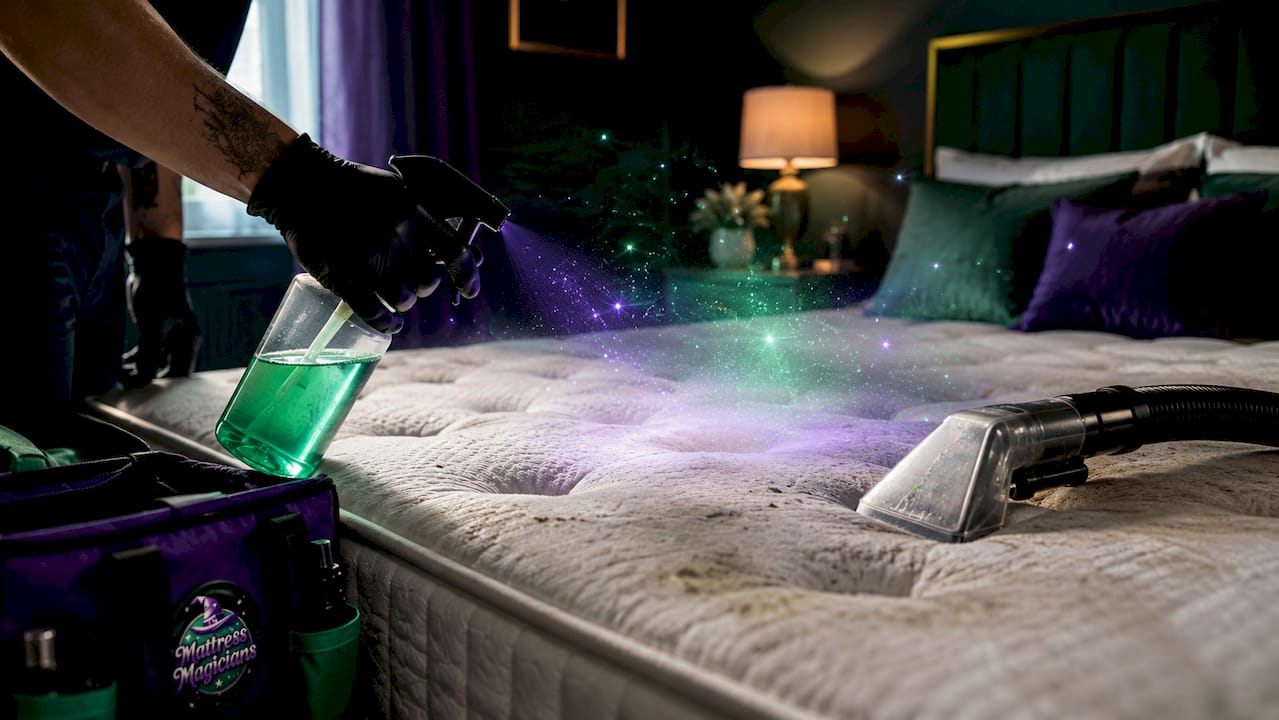
The term “mattress refresh” is informal. The recognized industry term is mattress deep cleaning, which includes vacuuming, stain treatment, deodorizing, and sanitization as distinct steps. Both phrases describe the same process, and you will see them used interchangeably throughout this guide.
What tools and products do you need for rental mattress cleaning?
The right equipment makes the difference between a surface clean and a genuine restoration. You do not need expensive machinery for a DIY refresh, but you do need the right products for each task.
Core cleaning supplies:
- Vacuum with upholstery and crevice attachments. Monthly vacuuming with upholstery attachments prevents allergen buildup between deep cleans. For post-tenant work, a thorough pass is non-negotiable.
- Enzyme-based cleaner. This is the single most important product for rental turnover. Enzyme cleaners break down organic compounds rather than masking them, making them far more effective on urine, sweat, and vomit than standard surface sprays.
- Baking soda. A large box is enough for a queen mattress. It draws out moisture and neutralizes acidic odors.
- Clean white cloths or microfiber towels. White cloths let you see what you are lifting from the mattress.
- Spray bottle. For applying enzyme cleaner in a controlled, light mist.
- Mattress protector. Install one before the next tenant moves in. It is the single best way to prevent this level of cleaning from being necessary again.
Protective gear:
- Disposable gloves (nitrile, not latex)
- An N95 or KN95 mask when dealing with heavy biological stains or visible mold
| Tool or product | Primary function |
|---|---|
| Vacuum with upholstery tool | Removes dust mites, skin cells, and surface debris |
| Enzyme-based cleaner | Breaks down biological stains and odors at the molecular level |
| Baking soda | Deodorizes and draws out residual moisture |
| Microfiber cloths | Blotting stains without spreading them |
| Mattress protector | Prevents future contamination between tenancies |
| Spray bottle | Controls moisture application to avoid over-wetting |
Pro Tip: Buy enzyme cleaner in a 32-oz or larger bottle. A single queen mattress with moderate staining can easily use half a bottle if the stains are set.
How do you remove stains, odors, and allergens step by step?
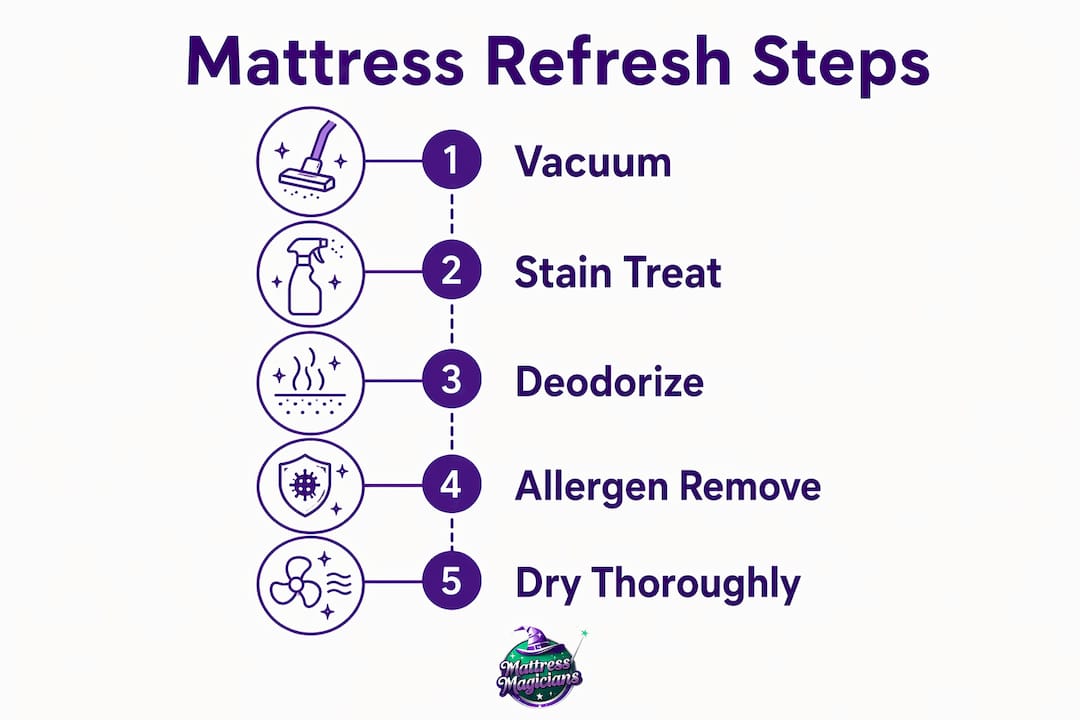
This process works for any mattress type, including memory foam, innerspring, and hybrid. The order matters. Skipping steps or reversing them reduces effectiveness.
-
Strip all bedding and wash it separately. Use the hottest water the fabric allows. Hot water kills dust mites and removes biological residue from sheets, mattress pads, and pillow covers before you touch the mattress itself.
-
Vacuum the entire mattress surface. Use the upholstery attachment in slow, overlapping passes. Follow with the crevice tool along seams and edges, where dust mites and debris concentrate. Do not rush this step.
-
Identify and pre-treat stains. Spray enzyme cleaner lightly onto each stain. Let it sit for 10–15 minutes. Then blot with a clean white cloth, working from the outside of the stain inward. Over-saturating the mattress pushes stains and bacteria deeper into the foam while creating conditions for mold growth. Use the minimum amount of liquid needed.
-
Blot, never rub. Rubbing spreads the stain and drives it into the mattress fibers. Blotting lifts it. This distinction is one of the most common mistakes in DIY mattress cleaning.
-
Apply baking soda across the full surface. After stain treatment, sprinkle a generous, even layer of baking soda over the entire mattress. Baking soda needs up to two hours to effectively deodorize before you vacuum it off. For heavy odors, leave it for the full two hours or longer.
-
Vacuum off the baking soda. Use the upholstery attachment again in slow passes. This step also removes allergen particles loosened during the deodorizing period.
-
Allow the mattress to dry completely. Drying time ranges from 4 to 24 hours depending on indoor humidity and ventilation. Stand the mattress upright against a wall if possible, and point a fan directly at it. Open windows if outdoor humidity is low.
-
Inspect under good lighting. Use a flashlight or phone light at a low angle across the mattress surface. This reveals remaining stains, damp spots, or areas that need a second treatment.
Pro Tip: For urine stains, apply enzyme cleaner, cover the area with a clean cloth, and place a heavy book on top for 10 minutes. The pressure helps the cleaner penetrate the same depth the urine reached.
A common mistake property managers make is cleaning the mattress the day before a new tenant arrives. That leaves no margin for extended drying time. Schedule the refresh at the start of the turnover window, not the end.
How do you schedule mattress cleaning around tenant turnover?
Timing is where most Twin Cities property managers lose ground. The cleaning itself takes one to two hours. The drying time is where the schedule breaks down.
Drying can take 4–24 hours under normal conditions. In the Twin Cities, that window extends further during humid summer months or in poorly ventilated apartments. Minnesota’s climate adds a real variable that property managers in drier regions do not face. A mattress that feels dry on the surface can still hold moisture internally, which leads to mold within days of being covered with bedding.
Scheduling best practices for Twin Cities rentals:
- Schedule mattress cleaning on day one or two of the turnover window, not the final day.
- Run a dehumidifier in the room during and after cleaning, especially between june and august.
- Use box fans or ceiling fans to maintain airflow throughout the drying period.
- Check the mattress at multiple depths before covering it. Press your palm firmly into the center and edges. Any coolness or dampness means it needs more time.
- For same-week turnovers, consider booking a professional service that uses extraction equipment, which removes far more moisture than DIY methods.
Cleaning frequency for rental mattresses should be every tenancy at minimum, or every six months for long-term tenants. Properties that allow pets or have high turnover rates need cleaning after every occupancy without exception.
When does DIY cleaning fall short?
DIY methods work well for light staining and routine odor control. They reach their limit quickly with deep-set biological stains, pet accidents, or mattresses that have gone months without any maintenance.
DIY methods are limited against deep-set stains and allergens. Baking soda and surface enzyme cleaners treat the top layer of foam or fabric, but urine from a pet or a child can penetrate several inches into a mattress. Surface treatment does not reach that depth. The odor returns within days of the new tenant moving in, and the allergen load stays high.
Signs that professional cleaning is the right call:
- Stains that have dried and set over weeks or months
- Any pet urine, which penetrates deeper and bonds differently than human urine
- Visible discoloration that covers more than a few square inches
- A persistent odor after two rounds of DIY treatment
- A tenant or incoming occupant with documented allergies or asthma
Professional services use hot water extraction or dry-compound methods that reach the interior of the mattress. They also apply commercial-grade enzyme treatments at concentrations not available in retail products. Professional cleaning creates a neutral scent profile that removes all traces of previous occupancy, which matters for tenant satisfaction and retention.
For property managers, professional cleaning also creates a paper trail. Documenting mattress condition with dated photos before and after cleaning, combined with professional receipts, supports security deposit claims. That documentation has real value in a dispute.
“Professional mattress cleaning goes beyond aesthetics. It removes the biological record of the previous tenancy, including odors, allergens, and stains that DIY methods leave behind. For property managers, that level of restoration protects both the next tenant’s health and the landlord’s legal standing.”
For allergen-sensitive tenants or high-turnover properties, Mattressmagicians recommends pairing a DIY maintenance routine with professional allergen removal treatment at least once per year.
Key Takeaways
A complete post-tenant mattress refresh requires stain treatment, deodorizing, allergen removal, and adequate drying time, in that order, before any new tenant moves in.
| Point | Details |
|---|---|
| Clean after every tenancy | Industry standards call for deep cleaning after each tenant, not just annually. |
| Use enzyme cleaners for biological stains | Enzyme cleaners break down urine and sweat at the molecular level; surface sprays do not. |
| Allow 4–24 hours to dry | Insufficient drying time leads to mold; schedule cleaning at the start of turnover, not the end. |
| Document before and after | Dated photos and professional receipts support deposit claims in tenant disputes. |
| Know when to call a professional | Deep-set stains, pet accidents, and allergen-sensitive tenants require professional extraction. |
What I have learned from Twin Cities rental cleanings
After working with property managers across Minneapolis, St. Paul, and Woodbury, the pattern I see most often is not a lack of effort. It is a lack of sequencing. Landlords vacuum, spray something, and consider the job done. The baking soda step gets skipped because it feels slow. The drying step gets cut short because the move-in date is tomorrow.
The mattresses that come back to us in the worst shape are not the ones that were never cleaned. They are the ones that were cleaned too quickly and covered back up while still damp. Mold sets in within 24–48 hours under bedding. By the time the next tenant notices the smell, the damage is internal and no amount of surface treatment fixes it.
The other thing I see consistently: property managers underestimate how much a clean mattress affects tenant perception at move-in. A fresh, odor-free mattress signals that the property is well managed. It sets a tone. Tenants who move into a unit with a stale or musty mattress start their tenancy with a complaint already forming.
My honest recommendation for anyone managing more than two or three units in the Twin Cities is to treat mattress cleaning the same way you treat carpet cleaning: budget for it, schedule it at every turnover, and bring in a professional for anything beyond routine maintenance. The cost is a fraction of what a replacement mattress runs, and the documentation it creates is worth the investment on its own. For bulk turnover situations, Mattressmagicians has a specific process for managing multiple units that keeps scheduling from becoming a bottleneck.
— Phillip
Mattressmagicians serves Twin Cities landlords and property managers
Mattressmagicians provides on-demand, mobile mattress cleaning across Minneapolis, St. Paul, Woodbury, and the surrounding Twin Cities metro. Same-week scheduling is available for property managers working within tight turnover windows.
Services cover the full post-tenant refresh process: stain and urine removal, odor elimination, allergen reduction, and full sanitization. Every service includes documentation you can use for deposit records. For Minneapolis-area properties, same-week mattress cleaning is the fastest way to get a mattress rental-ready without the risk of incomplete drying or missed stains. Book early in your turnover window to give the mattress the full drying time it needs before your next tenant arrives.
FAQ
How long does baking soda need to sit on a mattress?
Baking soda needs at least two hours on the mattress surface to effectively neutralize odors before you vacuum it off. For heavy odors from a long tenancy, leaving it for three to four hours produces better results.
How often should rental mattresses be professionally cleaned?
Industry standards recommend deep cleaning after every tenancy, or at minimum every six months for long-term tenants. Pet-friendly rentals and high-turnover properties need cleaning after every occupancy.
Can DIY cleaning fully remove urine stains from a mattress?
DIY enzyme cleaners treat surface-level urine stains effectively, but deep-set or older urine stains require professional extraction to reach the full depth of penetration. Surface treatment alone will not eliminate the odor permanently.
How long does a mattress take to dry after cleaning?
Drying time ranges from 4 to 24 hours depending on humidity and ventilation. In the Twin Cities during humid months, plan for the longer end of that range and use fans and a dehumidifier to speed the process.
Does professional mattress cleaning help with deposit disputes?
Dated photos combined with professional cleaning receipts create documentation that supports security deposit claims. This paper trail is particularly useful when a tenant disputes charges for mattress damage or excessive soiling.

