
TL;DR:
- A structured five-stage workflow cleans mattresses onsite in apartments, improving hygiene and tenant comfort. Using mattress-specific low-moisture equipment, property managers reduce damage and ensure rapid drying, saving costs. Integrating cleaning into turnovers with documentation and bundling services maintains asset value and tenant satisfaction.
An onsite mattress cleaning workflow for apartment buildings is a structured, multi-stage sanitation process designed to restore mattress hygiene between tenant occupancies without removing the mattress from the unit. Property managers who skip this process face compounding problems: dust mites, allergens, and bacteria accumulate invisibly inside mattress foam, degrading tenant comfort and shortening asset life. The IICRC S100 soft-surface cleaning standard defines the professional benchmark for this work. A properly executed workflow moves through five stages, inspection through rapid drying, and returns a mattress to ready-to-use condition within hours.
What are the key stages of an onsite mattress cleaning workflow in apartment buildings?
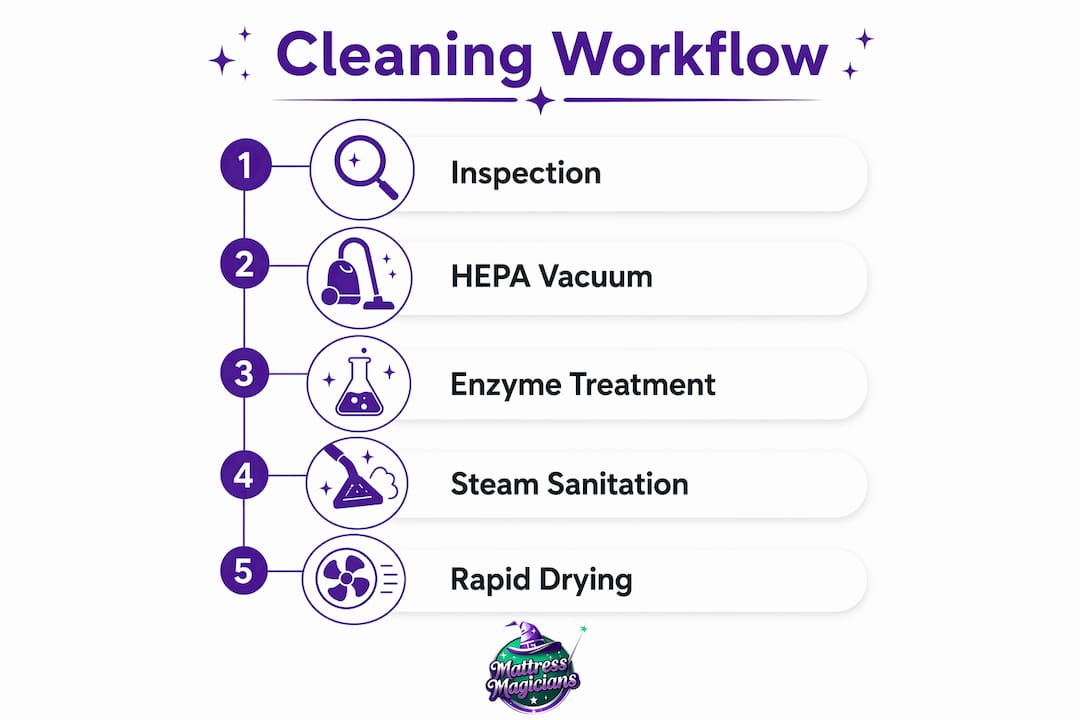
An efficient five-stage workflow covers inspection, HEPA vacuuming, enzyme stain treatment, low-moisture steam sanitation, and rapid drying. Each stage has a specific purpose, and skipping any one of them leaves the job incomplete.
Stage 1: Inspection and pre-clean audit
Every cleaning starts with a visual inspection of the entire mattress surface, sides, and underside. The technician documents stains, odors, structural damage, and signs of biological contamination such as urine or pet accidents. This audit determines which treatment products and equipment the job requires. It also creates a written record that protects the property manager if a tenant disputes the mattress condition at move-out.
Stage 2: HEPA vacuuming
HEPA-grade vacuuming removes surface debris, dead skin cells, dust mites, and loose allergens before any moisture is applied. Applying liquid to an unvacuumed mattress pushes surface contaminants deeper into the foam. A HEPA filter captures particles as small as 0.3 microns, which covers the size range of the most common airborne allergens. This step alone reduces allergens and dust mites measurably and improves indoor air quality for incoming tenants.
Stage 3: Enzyme stain and spot treatment
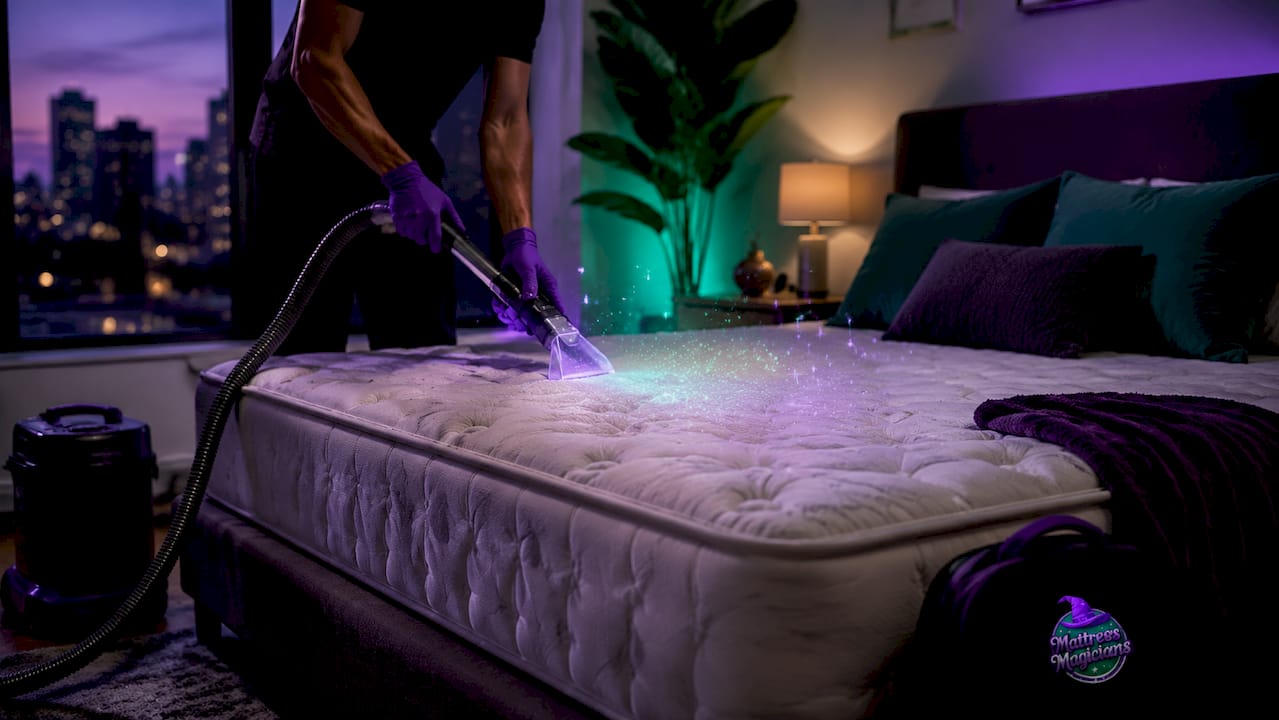
Enzyme-based products break down biological stains at the molecular level. Urine, sweat, and blood all respond to enzymatic treatment in a way that standard detergents cannot replicate. The technician applies the product to affected areas, allows dwell time for the enzymes to work, then extracts the residue. For eco-friendly stain removal, non-toxic enzyme formulas are the standard choice because they leave no harmful residue in a sleeping surface.
Stage 4: Low-moisture steam sanitation
Low-moisture steam reaches temperatures that kill bacteria, mold spores, and dust mite eggs without saturating the mattress. This is the step most often done wrong. Standard carpet steam machines deliver too much water volume for a mattress, which leads to over-wetting and foam damage. Mattress-specific extraction equipment controls moisture output precisely. The goal is sanitation without soaking.
Stage 5: Rapid drying
Industrial air movers accelerate drying to a fraction of the time passive air drying requires. A properly dried mattress is ready for use within a few hours rather than overnight. Fast drying also eliminates the window in which mold can begin to develop inside damp foam layers. Communicating the realistic drying period to tenants before the cleaning begins prevents complaints about mattress readiness and sets clear expectations.
Pro Tip: Schedule the cleaning at the start of the turnover day, not the end. That gives the mattress maximum drying time before the new tenant moves in.
Which tools and equipment are required for effective apartment mattress cleaning?
The right equipment is not optional. Using the wrong tools causes damage that costs more to fix than the cleaning saved.
| Equipment | Purpose | Key Specification |
|---|---|---|
| HEPA vacuum | Allergen and debris removal | Filters particles down to 0.3 microns |
| Low-moisture steam cleaner | Sanitation and microbial reduction | Mattress-specific, low water volume output |
| Enzyme-based treatment products | Stain and odor breakdown | Non-toxic, safe for sleeping surfaces |
| Industrial air mover | Rapid drying | High CFM output for fast moisture evaporation |
| UV-C sanitizing wand | Optional microbial reduction | Effective against surface bacteria and viruses |
The most critical item on that list is the low-moisture extraction unit. Standard carpet cleaners damage mattresses by delivering water volumes the foam cannot handle. Mattress-specific machines are engineered to clean and extract simultaneously at low moisture levels.
Key supply considerations for property managers coordinating onsite work:
- Enzyme products should be fragrance-free and certified safe for indoor air quality.
- UV-C wands add a measurable layer of microbial control for high-turnover or immunocompromised-tenant units.
- Air movers should be positioned to draw air across the mattress surface, not just blow at it from one angle.
- All equipment must fit through standard apartment doorways and elevator dimensions without disassembly.
How can property managers integrate mattress cleaning into apartment turnover workflows?
Mattress cleaning fits most naturally into the turnover window between a tenant moving out and a new tenant moving in. Synchronizing cleaning with turnover procedures reduces administrative burden and keeps unit downtime to a minimum. The key is treating mattress cleaning as a scheduled line item in the turnover checklist, not an afterthought triggered only by visible damage.
Practical integration steps for property managers:
- Add a mattress inspection field to your standard move-out checklist so housekeeping staff flag issues at the same time they document carpet and wall condition.
- Pre-book elevator access and service entry for the cleaning crew when you schedule other turnover vendors.
- Bundle mattress cleaning with carpet or upholstery services to reduce mobilization costs. Bundling these services reduces labor costs by 20–30% compared to scheduling each visit separately.
- Send tenants a brief note before move-in explaining that the mattress has been professionally cleaned and will be fully dry by their arrival time.
- Use a maintenance trigger system: any reported biological spill during a tenancy should prompt a spot-cleaning visit, not a wait until turnover.
Pro Tip: Create a two-line mattress hygiene card to leave on the cleaned mattress at move-in. It signals professionalism, sets hygiene expectations, and reduces the chance a tenant ignores a spill until it becomes a deep stain.
Tenant education is an underused tool. When tenants understand that proactive spot cleaning of biological spills prevents deep stains and odors, they are more likely to report accidents early. Early reporting means lower cleaning costs at turnover.
What common mistakes occur during onsite mattress cleaning in apartment buildings?
The most expensive mistake in apartment mattress sanitation is using the wrong equipment. A standard carpet cleaning machine applies far more water than a mattress can safely absorb. The result is saturated foam, extended drying times measured in days rather than hours, and a real risk of mold growth inside the mattress core. That mold is invisible from the surface and nearly impossible to remediate without replacing the mattress entirely.
“Low-moisture, mattress-specific extraction machinery is key to protecting internal structures and reducing drying times. Standard carpet steam machines are not suitable for mattresses.” — IICRC S100-aligned professional cleaning guidance
Other common errors that cost property managers money:
- Cleaning only visible stains and ignoring unseen allergen buildup. A mattress can look clean and still harbor significant concentrations of dust mite waste and sweat residue.
- Skipping the final inspection and drying verification. A mattress that feels dry on the surface can still hold moisture in its core layers.
- Failing to document the pre-clean and post-clean condition. Without documentation, disputes over mattress damage at move-out have no factual baseline.
- Rushing the enzyme dwell time. Enzymes need adequate contact time to break down biological material. Wiping them off too early leaves the stain partially treated and the odor source intact.
Final inspection and documentation are not administrative formalities. They are the quality control step that confirms the mattress meets hygiene standards and is genuinely ready for the next tenant.
What is the recommended cleaning frequency for apartment mattresses?
Cleaning frequency depends on occupancy type, not just calendar time. A one-size-fits-all annual schedule leaves high-risk units under-serviced and wastes budget on low-risk ones.
| Occupancy Type | Recommended Frequency | Primary Driver |
|---|---|---|
| High turnover or short-term rental | Every 6–9 months | Rapid tenant cycling, heavy use |
| Pet-friendly units | Every 6–9 months | Pet dander, accidents, odor buildup |
| Standard long-term rental | Annually | Allergen accumulation, sweat buildup |
| Allergy-sensitive tenant units | Every 6 months | Dust mite and allergen control |
Deep cleaning every 6–9 months for high-turnover or allergy-prone units is the professional standard. Annual cleaning covers standard long-term rentals adequately. These intervals are not arbitrary. Dust mite populations and allergen loads reach levels that affect tenant health within these timeframes if left unaddressed.
Monitoring tenant feedback and maintenance requests refines the schedule over time. A unit that generates repeated odor complaints likely needs a shorter interval. Bundling cleaning visits with other scheduled services, such as carpet cleaning or HVAC filter changes, keeps costs manageable and reduces the number of vendor visits per unit per year.
Key Takeaways
A structured onsite mattress cleaning workflow is the most cost-effective way for property managers to protect tenant health, preserve mattress assets, and reduce turnover costs.
| Point | Details |
|---|---|
| Five-stage workflow is the standard | Inspection, HEPA vacuuming, enzyme treatment, low-moisture steam, and rapid drying cover every hygiene need. |
| Equipment choice determines outcomes | Low-moisture, mattress-specific extraction equipment prevents foam damage and mold risk. |
| Integration reduces costs | Bundling mattress cleaning with turnover services cuts labor costs by 20–30%. |
| Frequency depends on occupancy type | High-turnover and pet-friendly units need cleaning every 6–9 months; standard rentals need annual service. |
| Documentation protects property managers | Pre-clean and post-clean records create a factual baseline for move-out disputes. |
What I’ve learned from watching property managers get this wrong
I’ve seen the same pattern repeat across apartment buildings in the Twin Cities. A property manager runs a tight ship on carpets and appliances, then treats the mattress as a furniture item that cleans itself. The mattress gets a wipe-down between tenants, maybe a spray of fabric freshener, and a new cover. The next tenant moves in, and within a few weeks, they’re complaining about odors or allergy symptoms they didn’t have at their last place.
The root problem is that mattress hygiene is invisible. Carpet stains are obvious. A mattress can look perfectly acceptable and still be a significant allergen source. That invisibility makes it easy to deprioritize. The cost shows up later, in tenant complaints, early lease terminations, and mattresses that need replacing years before their expected lifespan ends.
The fix is not complicated. It’s treating mattress cleaning as a scheduled maintenance task with the same discipline you apply to HVAC filters or fire alarm testing. When you integrate it into the turnover checklist and bundle it with other services, the per-unit cost becomes genuinely reasonable. The property managers I’ve seen do this well don’t think of it as an added expense. They think of it as protecting an asset that costs several hundred dollars to replace and costs almost nothing to maintain properly.
The other thing worth saying plainly: DIY mattress cleaning with consumer-grade equipment rarely achieves the sanitation depth that professional service does. The enzyme products, HEPA vacuums, and low-moisture extraction units that professionals use are not available at the hardware store. When a mattress has biological contamination from urine, pet accidents, or significant sweat buildup, professional service is not a luxury. It’s the only method that actually works.
— Phillip
Mattressmagicians serves apartment buildings across the Twin Cities
Property managers in Minneapolis, St. Paul, and the surrounding metro area work with Mattressmagicians for onsite apartment mattress cleaning that fits into existing turnover schedules without disruption.
Mattressmagicians uses HEPA-grade vacuuming, non-toxic enzyme treatments, and low-moisture extraction equipment on every job. Drying times are fast enough to keep units on schedule. The team handles professional mattress cleaning for single units and multi-building portfolios, with flexible scheduling built around your turnover windows. For units with specific concerns, mattress sanitization and odor removal services are available as standalone or bundled options. Contact Mattressmagicians at mattressmagicians.com to schedule service or request a commercial inquiry.
FAQ
What does an onsite mattress cleaning workflow include?
A professional onsite mattress cleaning workflow covers five stages: inspection, HEPA vacuuming, enzyme stain treatment, low-moisture steam sanitation, and rapid drying. The process returns a mattress to hygienic, ready-to-use condition within hours.
How often should apartment mattresses be professionally cleaned?
High-turnover and pet-friendly units need professional cleaning every 6–9 months. Standard long-term rental units benefit from at least annual service to control allergen and dust mite accumulation.
Can standard carpet cleaning equipment be used on mattresses?
Standard carpet cleaning machines deliver too much water volume for mattresses and cause foam damage, extended drying times, and mold risk. Low-moisture, mattress-specific extraction equipment is required for safe and effective results.
Does bundling mattress cleaning with other services save money?
Bundling mattress cleaning with carpet or upholstery services during turnover reduces labor costs by 20–30% through consolidated mobilization. It also reduces the number of vendor visits per unit per year.
How do property managers schedule onsite mattress cleaning efficiently?
Schedule mattress cleaning at the start of the turnover window, pre-book elevator and unit access alongside other vendors, and add a mattress inspection field to the standard move-out checklist. This approach minimizes unit downtime and keeps the workflow integrated with existing procedures.