
TL;DR:
- A six-step professional mattress cleaning workflow integrates inspection, linen removal, HEPA vacuuming, spot treatment, deep cleaning, and thorough drying. This process prevents health risks, extends mattress lifespan, and requires strict adherence to safety and moisture protocols. When damage or contamination exceeds cleaning capabilities, replacement becomes necessary to ensure occupant safety.
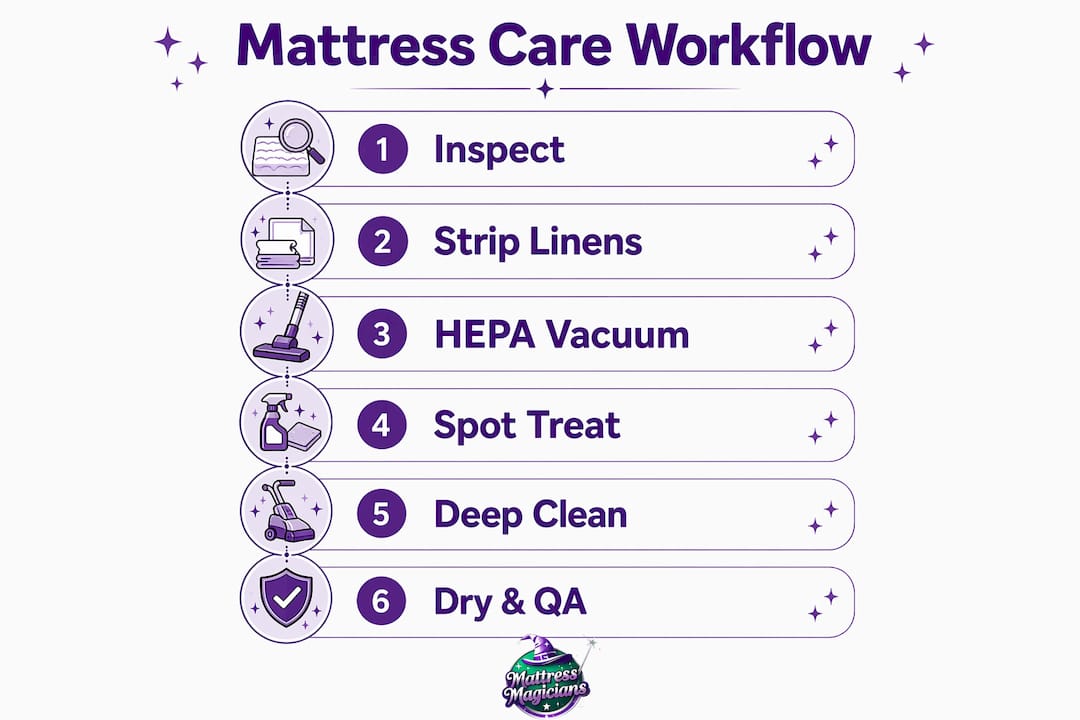
The fastest way to protect a mattress and the guests sleeping on it: inspect → strip and bag linens → HEPA vacuum → spot-treat with enzymes → deep-clean using the right method for the mattress type → dry to a safe moisture threshold and document everything. That six-step sequence is the backbone of every professional in-room service call, whether you manage a single Airbnb in St. Paul or a 40-room motel in Woodbury.
Here is the staff-ready checklist version:
- Inspect for red flags (mold, bed bugs, heavy saturation, structural damage)
- Don PPE, strip linens head-to-foot, bag contaminated items
- HEPA vacuum all surfaces, seams, and edges
- Blot and enzyme-treat stains; allow proper dwell time
- Select and perform the correct deep-clean method for the mattress construction
- Dry with air movers to safe moisture levels; photograph and log the job
Red-line rule: Active mold, confirmed bed bugs, or severe structural damage means stop and call a professional immediately. These are not DIY situations.
Table of Contents
- Your printable in-room mattress care checklist
- What to check before you touch the mattress
- How to strip the room and handle bio-soiled linens safely
- Step 3: HEPA vacuuming removes what wet treatments cannot
- Spot treatment: the right sequence for stains and bio-soils
- How to choose the right deep-clean method by mattress type
- Drying strategy: hitting safe moisture thresholds
- Final QA, photo documentation, and re-occupancy timing
- When to restore vs. when to replace
- PPE, ventilation, and safe chemical handling
- Estimated time and cost for Twin Cities mattress cleaning
- Key Takeaways
- A local pro’s perspective on in-room mattress care
- Mattressmagicians handles the jobs that need professional hands
- Useful sources and further reading
- FAQ
Your printable in-room mattress care checklist
A job card property managers and housekeeping staff can print and keep on the cart:
- Record room number, technician name, date, time started
- Conduct visual pre-inspection; photograph any stains, damage, or odors noted
- Don nitrile gloves, N95 mask, eye protection, and apron
- Strip linens head-to-foot; bag bio-soiled items in leakproof, labeled bags
- HEPA vacuum top, sides, seams, handles, and flanges (slow overlapping passes)
- Spot-treat stains with enzyme cleaner; blot, do not rub; allow 10–15 minute dwell
- Select deep-clean method based on mattress type (see Section 7)
- Apply EPA-registered disinfectant where required; follow label contact time
- Position air movers; document moisture reading before and after drying
- Final QA inspection: odor check, visual stain check, surface dryness confirmed
- Photograph after; log method used, moisture reading, and technician initials
- Record time finished; advise on re-occupancy timing
Staff reminder: Communicate with the occupant or property owner before entering. Post signage if the room is temporarily out of service. For multi-unit building workflows, document each unit separately. Rotating mattresses every three months and using quality waterproof protectors meaningfully extends bedding lifespan between service calls.
What to check before you touch the mattress
Inspection determines whether an in-room job is safe and appropriate. A two-minute scan before any cleaning begins protects both the technician and the next guest.
Scan for these red flags:
- Visible wetness or dark saturation patches (especially center or edges)
- Ammonia or musty odor indicating urine or mold
- Visible mold colonies (black, green, or white fuzzy growth on seams or surface)
- Live or shed bed bug casings, blood spots, or fecal dots along seams
- Deep sagging beyond typical acceptable wear or open seam splits exposing foam core
- Heavy biological soiling beyond surface level
If any of these are present, escalate immediately. Active infestation, structural collapse, or deep mold colonization requires a different protocol than a standard service call.
Occupant communication steps: Post an “Out of Service” sign, notify the property manager, and isolate the room. Log the condition with timestamped photos before touching anything.
Pro Tip: A moisture meter reading taken at the start of the job documents pre-existing dampness. That single data point has resolved more billing disputes than any verbal explanation.
How to strip the room and handle bio-soiled linens safely
Strip and bag linens immediately using PPE. Treat any linen with visible bodily fluids as potentially biohazardous.
- Put on nitrile gloves and apron before touching bedding
- Remove pillowcases first, then top sheet, then fitted sheet, rolling inward to contain soils
- Place contaminated items directly into a leakproof, labeled bag; never shake them out
- Seal and transport bags to the laundry area per property protocol
- Check the mattress surface for any items left by the occupant before proceeding
A few things worth noting: check manufacturer care labels on mattress covers before any wet treatment, since some covers are not removable or machine-washable. If the mattress has no protector and soiling is present, place a temporary barrier (a clean plastic sheet or disposable pad) on the floor to catch any drips during treatment. Review how to prepare mattresses for new residents for move-in protocols that go beyond a standard turnover.
Step 3: HEPA vacuuming removes what wet treatments cannot
Commercial HEPA vacuums capture fine particulates, mite bodies, and skin cells rather than redistributing them through exhaust, which is exactly why vacuuming comes before any moisture is introduced.
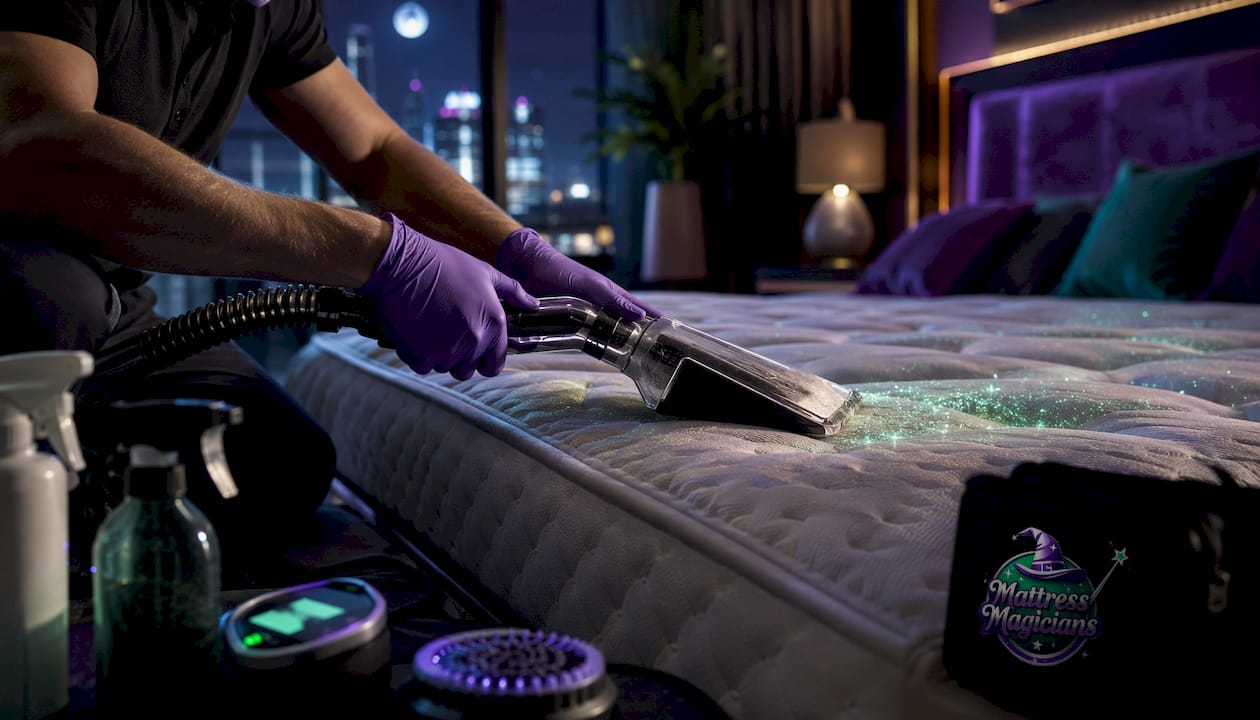
Equipment needed: Commercial HEPA vacuum with upholstery tool and crevice attachment.
How to vacuum a mattress properly:
- Start at the top center; use slow, overlapping passes (about 2 inches per second)
- Work toward the edges, then vacuum all four sides
- Use the crevice tool along seams, handles, and the mattress flange
- Flip or tilt the mattress if accessible; vacuum the underside
- Log vacuuming time in job notes and capture a “before” photo for QA
A queen mattress takes roughly 10–15 minutes done properly. Rushing this step means the downstream stain treatment and sanitization are working against a layer of particulate debris.
Spot treatment: the right sequence for stains and bio-soils
Targeted spot treatment — blot, enzyme dwell, gentle agitation, extraction — prevents stain-setting and limits moisture exposure to the foam layers beneath.
Sequence for protein-based stains (urine, blood, sweat):
- Blot excess moisture with a clean white cloth; work from the outside of the stain inward
- Apply an enzyme cleaner directly to the stain; do not saturate
- Allow 10–15 minutes dwell for fresh stains; older stains may need 20–30 minutes
- Gently agitate with a soft brush; blot again to lift the broken-down soil
- Rinse with a neutral pH solution applied sparingly; extract with a low-moisture tool
For oil or grease stains, use an oxygen-based agent instead of an enzyme cleaner. General dirt responds well to a mild surfactant. Never use bleach or ammonia-based products on foam or latex — both degrade cell structure and void most manufacturer warranties.
Pro Tip: Log the stain location, the product used, and the dwell time on the job card. That record protects you if a guest disputes pre-existing damage and helps the next technician know what was already treated.
For persistent urine odor, the stain and urine removal service goes deeper than surface treatment alone.
How to choose the right deep-clean method by mattress type
The core rule: use the least-invasive method that achieves sanitization. Over-wetting a mattress voids many warranties and creates mold risk, especially in foam and latex constructions.
| Method | Best for | Moisture risk | Typical duration |
|---|---|---|---|
| Low-moisture encapsulation | Memory foam, latex | Low | 45–90 minutes |
| Dry vapor / dry steam | All types, especially foam | Low–medium | 30–60 min |
| Hot water extraction | Innerspring, durable hybrids | Medium–high | 60–120 minutes |
| UV-C surface sanitation | All types (supplement only) | None | 10–20 min |
| Enzyme/deodorizer treatment | Bio-soils, odor control | Low | 20–45 minutes |
Key cautions:
- Foam and latex: avoid high heat and excess water; dry steam or low-moisture encapsulation is the safer choice
- UV-C does not penetrate foam; use it after extraction or steam, never as a standalone treatment
- Always check the manufacturer’s care tag before selecting a method
EPA-registered disinfectants belong in the workflow when a mattress has confirmed biological contamination. Follow label contact times exactly; do not rinse prematurely. For a detailed look at professional sanitization methods, the service page covers what each approach targets.
Drying strategy: hitting safe moisture thresholds
Fast, controlled drying is mandatory. Target surface dryness and interior moisture below approximately 12% (confirmed with a moisture meter) before remaking the bed.
| Clean method | Typical drying time |
|---|---|
| Low-moisture encapsulation | 1–3 hours |
| Dry steam | 1–2 hours |
| Hot water extraction (light) | 4–6 hours |
| Hot water extraction (heavy saturation) | 8–12 hours |
Equipment and setup:
- Position commercial air movers to create cross-flow across the mattress surface, not blowing directly into the foam
- Run a dehumidifier; target room humidity between 30–50%
- Check moisture readings at 30-minute intervals until the reading holds below 12%
- Document each reading with a timestamp
Commercial air movers and dehumidification commonly reduce drying to just a few hours. Skipping this equipment and leaving a mattress to air-dry in a closed room risks secondary mold growth before the core fully dries.
Final QA, photo documentation, and re-occupancy timing
Final QA confirms moisture control, odor resolution, and stain outcome. Only after QA passes should a room return to service.
QA checklist:
- Moisture meter reads below 12% at multiple points across the surface
- No residual odor detectable at nose level
- Stains resolved or documented as pre-existing and unresolvable
- Surface feels neutral to the touch (no dampness, no stickiness)
- After photo taken and attached to the job record
Sample message for property managers to send guests: “Your mattress was professionally cleaned and sanitized today. The bed will be ready to remake by [time]. A job record is available on request.”
Pro Tip: A one-page job receipt left for the client, noting the method used, moisture readings, and recommended next service interval, turns a single cleaning into a relationship. Clients who see the documentation book again.
Photo documentation and moisture readings are standard QA practice among professional providers and reduce disputes significantly.
When to restore vs. when to replace
Restore when cleaning can remove biological contamination and the mattress still provides structural support. Replace when it cannot.
Decision checklist:
- Urine saturation: Surface-level and recent — restore. Saturated through to the core with persistent ammonia odor after treatment — replace.
- Mold: Surface mold on the cover, caught early — treat and restore. Mold visible inside seams or foam layers — replace.
- Bed bugs: Confirmed infestation — seal and dispose immediately; do not attempt to clean in place. A confirmed positive requires room closure, mattress disposal in sealed tamper-evident bags, and a licensed pest management provider within 12 hours.
- Structural damage: Significant sagging, broken coils, or open seams exposing foam — replace.
- Persistent odor: Odor that survives a full professional deep-clean cycle — replace.
Restoration typically costs a fraction of replacement. But a cleaned mattress with a collapsed core is still a bad mattress. The cleaning bill changes nothing about a sag.
Pro Tip: For Airbnb hosts in the Twin Cities, photograph the mattress at every turnover. That visual record is your best defense against a guest claiming damage that was already there.
PPE, ventilation, and safe chemical handling
PPE and ventilation protect both the technician and the next occupant. This is not optional for bio-soiled jobs.
Required PPE for standard mattress treatments:
- Nitrile gloves (minimum; double-glove for heavy bio-soils)
- N95 or equivalent respirator for dusty jobs or mold-adjacent work
- Safety glasses or goggles when applying spray chemicals
- Disposable apron or waterproof coveralls for urine remediation
Safe chemical handling rules:
- Read and follow every product label; contact time matters
- Never mix bleach and ammonia-based products
- Store chemicals in original containers, away from heat and direct sunlight
- Use EPA-registered disinfectants only where the label specifies mattress or upholstery use
- Ventilate the room during and after chemical application; keep the door open and run a fan
Do not allow re-entry until fumes have fully dissipated. Document ventilation steps on the job card.
Estimated time and cost for Twin Cities mattress cleaning
Typical on-site time per queen mattress runs 60–180 minutes total, covering inspection, cleaning, and drying prep. Drying after cleaning is usually completed within a few hours when commercial air movers and dehumidifiers are used. Price varies with severity and service type.
| Service type | Estimated time | Typical US price range |
|---|---|---|
| Surface refresh and vacuum | 30–60 min | — |
| Stain spot treatment | 45–90 minutes | — |
Factors that push costs higher: heavy saturation, multiple mattresses in one visit, same-day or emergency scheduling, and travel to outer metro areas. For hospitality clients, hotels and high-turnover properties benefit most from scheduled biannual professional deep cleans paired with quarterly inspections, which reduces emergency call costs over time. Book mid-morning for same-day readiness where possible.
Key Takeaways
A documented six-step in-room workflow, matched to mattress type and followed through to a verified moisture threshold, is the single most effective way to protect occupant health and extend mattress life.
| Point | Details |
|---|---|
| Inspect before touching | Check for mold, bed bugs, saturation, and structural damage before any treatment begins. |
| HEPA vacuum first | Remove particulates before wet treatments to improve stain and sanitization results. |
| Enzyme cleaners for bio-soils | Allow 10–15 minute dwell for fresh stains; extract and dry thoroughly after treatment. |
| Match method to mattress type | Use low-moisture or dry steam for foam and latex; reserve hot water extraction for innerspring and hybrids. |
| Dry to below 12% moisture | Confirm with a meter before remaking; use air movers and a dehumidifier for controlled drying. |
| Call Mattressmagicians when needed | Structural damage, heavy saturation, mold, or bed bugs require professional intervention. |
A local pro’s perspective on in-room mattress care
The workflow in this article is sound, and most property managers who follow it will see real results. But there is one thing the checklist cannot capture: judgment about when a mattress is past the point of cleaning.
In the Twin Cities, seasonal humidity swings create conditions that accelerate mold risk in ways that warmer, drier markets do not face the same way. A mattress that dries fine in July can trap moisture for days in a cold, low-ventilation room in February. That means drying timelines here are not fixed numbers — they are starting points that require a moisture meter to confirm.
For Airbnb hosts managing high-turnover properties in Minneapolis or St. Paul, the temptation is to clean everything and replace nothing. That works until it does not. A mattress with deep urine saturation that has been surface-treated three times is not a clean mattress. It is a liability. The odor will return, usually when a guest is already in the room.
The workflows here are designed to catch that situation before it becomes a review problem. Use the decision checklist in Section 10 seriously. When the answer is “replace,” replace it. When the answer is “restore,” do it right — with the right equipment, the right chemistry, and documented proof that the job was done.
Mattressmagicians handles the jobs that need professional hands
When the workflow above reveals a mattress that needs more than a property team can safely handle, Mattressmagicians provides on-demand, in-room mattress cleaning and restoration across Minneapolis, St. Paul, Woodbury, and the surrounding Twin Cities metro.
The service covers the full range: professional mattress cleaning, sanitization, stain and urine removal, odor elimination, and allergen reduction — all performed on-site without moving the mattress. Same-week and emergency booking options are available for property managers and Airbnb hosts who need a room back in service fast. For local searches, the Minneapolis service page has current availability and booking details.
Document before-and-after photos before the technician arrives. It protects you, speeds the job, and gives you a record for any guest or owner dispute. Book at mattressmagicians.com.
Useful sources and further reading
- How Often Should Hotels Clean Their Mattresses? — hospitality cleaning frequency guidance
- Mattress Deep Cleaning: Pro vs. DIY — enzyme protocols, HEPA vacuuming, and UV-C use
- Mattress Cleaning vs. Replacement — professional workflow steps and QA documentation standards
- Mattress Cleaning vs Replacement: Save 95% Today — drying timelines, moisture risk, and foam/latex cautions
- The Hotelier’s Guide to Extended Bed Lifespan — rotation schedules, protector protocols, and environmental controls
- Mattressmagicians Sanitization Service — Twin Cities professional sanitization methods
- Onsite Mattress Cleaning for Apartment Buildings — multi-unit workflow logistics
FAQ
How long does an in-room mattress cleaning take?
Most professional visits run 60–180 minutes per queen mattress, including inspection, cleaning, and drying prep. Drying alone can add 2–6 hours depending on the method and saturation level.
What cleaning method is safe for memory foam and latex?
Low-moisture encapsulation or dry steam is the recommended approach. Hot water extraction carries a higher moisture risk for foam constructions and can void manufacturer warranties if the core is over-wetted.
When should a mattress be replaced instead of cleaned?
Replace when sagging is significant, when odor persists after a full professional deep-clean cycle, when mold has penetrated beyond the surface, or when bed bugs are confirmed. Cleaning cannot fix structural failure.
How often should hospitality properties schedule professional mattress cleaning?
High-occupancy properties benefit from biannual professional deep cleaning paired with quarterly visual inspections and rotation. Lower-occupancy units may extend to annual professional service.
Can Mattressmagicians handle emergency same-week bookings in the Twin Cities?
Yes. Mattressmagicians offers same-week and emergency booking for property managers and hosts across Minneapolis, St. Paul, and the surrounding metro. Visit mattressmagicians.com to check availability.

