
Your mattress may look perfectly clean, but right now it could be hosting millions of microscopic squatters. Dust mite populations in a single mattress can reach anywhere from 1.5 to 10 million, and regular vacuuming barely puts a dent in those numbers. For Twin Cities homeowners, the humid Minnesota summers make this problem significantly worse than in drier climates. This guide explains exactly why mattresses attract dust mites, what that means for your family’s health, and which eco-friendly prevention methods actually deliver lasting results instead of just temporary relief.
Table of Contents
- Why mattresses attract dust mites: The hidden science
- Dust mite risks and how they impact your health
- What makes Twin Cities homes a dust mite hotspot?
- Proven eco-friendly solutions for dust mite control
- Why single solutions rarely work and what most guides miss
- Professional mattress care for Twin Cities families
- Frequently asked questions
Key Takeaways
| Point | Details |
|---|---|
| Mattress conditions favor mites | Mattresses provide warmth, humidity, and food that help dust mites thrive even in clean homes. |
| High allergen risk | Dust mite waste is a major cause of allergies and asthma, especially when Der p 1 allergen levels are elevated. |
| Twin Cities homes are high-risk | Frequent high humidity and limited mattress airing make local homes especially prone to mite infestations. |
| Eco-friendly control works best | Combining mattress encasements, hot washes, and humidity control reduces dust mites dramatically without harsh chemicals. |
| Professional help is available | Local mattress cleaning services use proven, safe methods to eliminate dust mites and improve sleep quality. |
Why mattresses attract dust mites: The hidden science
Most people assume a clean-looking bed is a safe bed. That assumption is wrong, and understanding why changes everything about how you approach mattress hygiene.
Dust mites are not attracted to dirt in the traditional sense. They are attracted to you. Every night, a single person sheds roughly 1.5 grams of dead skin cells. That sounds small, but it is more than enough to feed thousands of mites for days. Your mattress collects this material continuously, night after night, year after year, building up a food supply that is essentially unlimited from a mite’s perspective.
But food alone does not explain the problem. Mattresses also provide the perfect microclimate. Dust mites thrive at temperatures between 20 and 25°C (68 to 77°F) and require relative humidity above 50% to survive and reproduce. Your body heat warms the mattress surface to exactly that range every single night. Your sweat and breath raise the local humidity well above 50%. The result is a warm, moist, food-rich environment that is nearly ideal for mite colonies to explode in size.
Mattresses attract dust mites because they provide an abundant, continuous food source of dead human skin cells, ideal warmth, high humidity, and protective fibrous structures. That last point matters more than most people realize. The fibrous interior of a mattress gives mites places to hide deep inside where no vacuum can reach them. Even a thorough surface vacuuming only removes mites and debris from the top layer.
| Condition | Dust mite preference | Typical mattress level |
|---|---|---|
| Temperature | 20 to 25°C | 26 to 30°C near surface |
| Relative humidity | Above 50% | 55 to 70% after sleep |
| Food source | Dead skin cells | 1.5g shed per person per night |
| Shelter | Fibrous materials | Dense foam and fabric layers |
“A single mattress can harbor over a million dust mites, even in homes that are regularly cleaned and vacuumed.”
Here is what makes this especially frustrating: mite populations can reach 1.5 to 10 million in a mattress that looks and smells completely fresh. Standard vacuuming removes surface debris but does not penetrate deep enough to reach established colonies. This is why surface-level cleaning gives homeowners a false sense of security while the actual problem keeps growing underneath.
Key reasons mattresses become mite habitats so quickly:
- Continuous food supply from nightly skin shedding
- Body heat maintaining ideal mite temperatures every night
- Sweat and breath pushing humidity above mite survival thresholds
- Dense mattress materials providing shelter from surface cleaning
- Lack of airflow inside the mattress trapping heat and moisture
Pro Tip: Pull back your bedding for at least 30 minutes every morning before making your bed. This lets surface moisture evaporate and temporarily drops the humidity in your mattress, making conditions slightly less hospitable for mites. It is a small habit with a real impact over time.
If you want to go further than surface habits, a professional mattress sanitization service uses heat and specialized equipment to reach mite colonies that household tools simply cannot access.
Dust mite risks and how they impact your health
Understanding why mites thrive leads to an even bigger concern: how they impact the health of you and your family.
Dust mites themselves do not bite. The real problem is what they leave behind. Their waste particles and shed body fragments are among the most potent indoor allergens known to science. When these particles become airborne, you breathe them in. When they settle into your bedding, your skin contacts them for eight hours every night.
The specific allergen that causes the most harm is called Der p 1. This protein, found in mite waste and body fragments, is small enough to penetrate deep into the airways. Der p 1 allergen at concentrations above 2 micrograms per gram of dust is directly linked to sensitization, meaning your immune system learns to overreact to it. Once sensitized, even low-level exposure can trigger symptoms.
Common symptoms linked to mattress dust mite exposure:
- Waking up with a stuffy or runny nose that clears during the day
- Itchy, watery eyes that are worst in the morning
- Nighttime coughing or wheezing that disrupts sleep
- Eczema flares that seem to worsen after sleeping
- Persistent sneezing that starts shortly after getting into bed
- Daytime fatigue caused by disrupted, low-quality sleep
Children are particularly vulnerable because their immune systems are still developing and they spend more time in bed relative to their body weight. In the Twin Cities, where summer humidity already stresses the respiratory system, kids with undiagnosed dust mite allergies are often misidentified as having seasonal allergies or frequent colds.
| Symptom | Seasonal allergy pattern | Dust mite allergy pattern |
|---|---|---|
| Timing | Outdoors in spring/fall | Indoors, worst at night and morning |
| Location | Worse outside | Worse in bedroom |
| Seasonality | Peaks with pollen | Year-round, worse in humid months |
| Relief | Leaving the area | Improves away from home |
Asthma sufferers face the most serious risk. Repeated exposure to Der p 1 can both trigger existing asthma attacks and, in children, actually contribute to developing asthma in the first place. For families already managing respiratory conditions, the mattress is not just an inconvenience. It is an active health risk.
For practical guidance on reducing allergen load in your home, the mattress cleaning tips on our blog cover specific steps for allergy-prone households in the Twin Cities.
What makes Twin Cities homes a dust mite hotspot?
With health concerns clear, it is important to look at what makes local homes especially vulnerable to dust mites.
The Twin Cities sit in a climate zone that delivers the worst of both worlds for mite control. Winters are cold and dry, which does help suppress mite populations temporarily. But summers are a different story entirely. Humid Twin Cities summers, with relative humidity routinely between 60 and 75%, create conditions that are almost perfectly calibrated for dust mite reproduction. That is a full 10 to 25 percentage points above the 50% threshold mites need to survive.
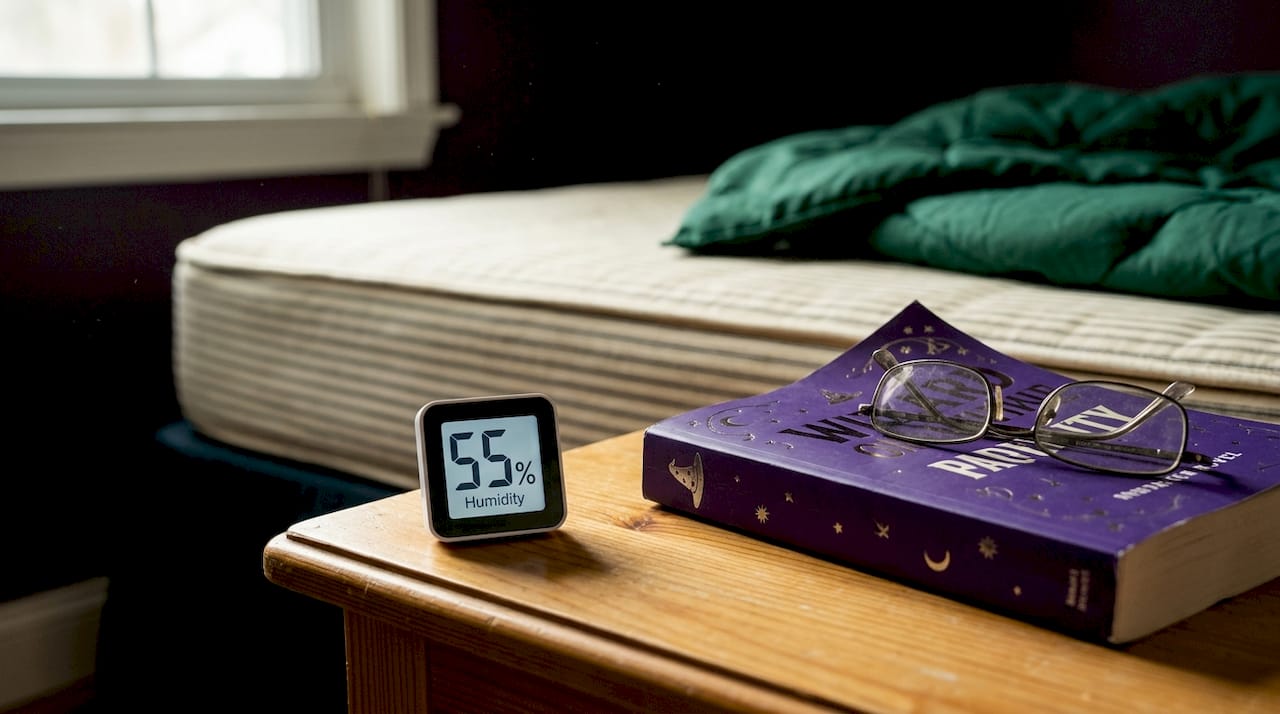
During those humid months, even running central air conditioning does not always bring indoor humidity down enough. Many Twin Cities homes use AC primarily for temperature control, not dehumidification, and the result is a cool but still humid bedroom that gives mites everything they need.
Several local lifestyle factors compound the problem:
- Closed windows in winter mean mattresses go months without fresh airflow or sunlight exposure, both of which naturally suppress mite populations
- In-bed activities like eating, working from home, or letting pets sleep in the bed dramatically increase the food supply available to mites
- Dense older housing stock in Minneapolis and St. Paul neighborhoods often has less ventilation than newer builds, trapping humidity indoors longer
- Infrequent mattress rotation or airing means the same zones of the mattress collect moisture and skin debris without any disruption
The average Twin Cities homeowner replaces their mattress every 8 to 10 years. That is nearly a decade of nightly skin shedding and humidity accumulation with minimal deep cleaning in between.
Pro Tip: Invest in a simple digital hygrometer (a humidity meter) for your bedroom. They cost less than $15 at most hardware stores and give you real-time data on whether your bedroom humidity is in the danger zone for mites. If it reads above 50%, your dehumidifier needs to run more.
Eco-friendly prevention in this climate starts with humidity control as the foundation. Organic mattress encasements, natural fiber bedding that breathes better, and strategic ventilation all work together to make your bedroom less hospitable to mites without relying on chemical sprays. If you are ready to address the root cause, Minneapolis mattress cleaning from a local provider who understands regional humidity patterns makes a significant difference.
Proven eco-friendly solutions for dust mite control
Given these local challenges, let us walk through eco-friendly solutions that are both evidence-based and safe for Twin Cities families.
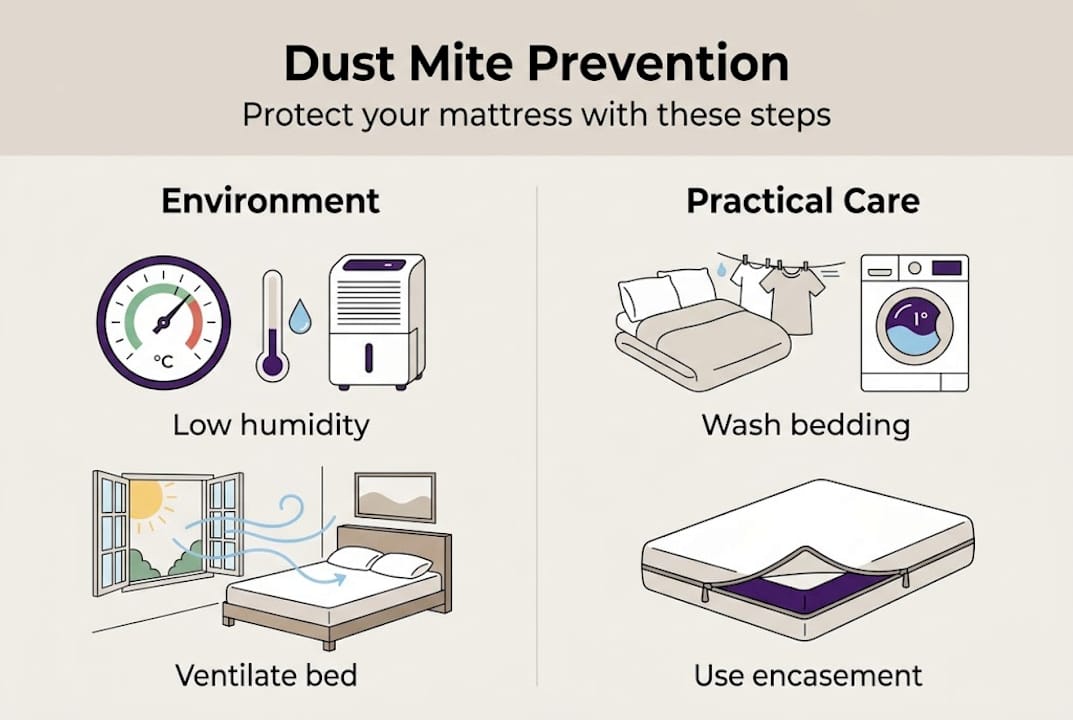
The good news is that the most effective dust mite control methods are also the most environmentally responsible ones. Chemical sprays are not only potentially harmful to children and pets, they also produce inconsistent results because mites can retreat deeper into the mattress when disturbed. Physical and thermal methods are more reliable and leave no toxic residue.
Step-by-step eco-friendly dust mite control plan:
- Install allergen-proof encasements on your mattress and pillows. Look for encasements with pore sizes smaller than 6 microns. Mites and their waste particles cannot pass through, which starves existing colonies and blocks new ones from establishing.
- Wash all bedding weekly in hot water. Weekly hot washes at temperatures at or above 54°C (130°F) kill mites and remove allergens effectively. Cold water washing, even with detergent, does not kill mites. It just moves them around.
- Control bedroom humidity below 50% using a dehumidifier rated for your room size. This is the single most impactful environmental change you can make. Mites cannot reproduce below 50% relative humidity and begin dying off within days.
- Vacuum with a HEPA-filter vacuum monthly, paying close attention to the mattress surface, seams, and surrounding floor. HEPA filters trap particles as small as 0.3 microns, preventing allergens from being blown back into the air during vacuuming.
- Consider a natural latex mattress for your next replacement. Natural latex mattresses are inherently resistant to mites because latex does not absorb moisture the way synthetic foams and innerspring systems do. They also resist mold and mildew, which often accompanies mite infestations.
- Air your mattress regularly. Strip the bed, open windows on dry days, and let the mattress breathe for at least an hour. Sunlight exposure, when possible, adds UV exposure that kills surface mites.
Multi-component interventions combining encasements, hot washing, and humidity control below 50% achieve up to a 98% reduction in mite populations. That is the kind of result that single-method approaches simply cannot match.
“The most effective eco-friendly approach combines physical barriers, thermal treatment, and environmental control. No single method comes close to achieving what all three together can accomplish.”
Pro Tip: When buying a mattress encasement, check that it is certified by an independent organization like OEKO-TEX or the Asthma and Allergy Foundation of America. These certifications confirm that the product is free from harmful chemicals and that the pore size actually blocks allergens.
For families who want a professional reset before starting a maintenance routine, professional mattress cleaning removes the existing mite load so your ongoing prevention efforts start from a much cleaner baseline. Mattress Magicians Twin Cities uses non-toxic, eco-friendly solutions that are safe for kids and pets.
Why single solutions rarely work and what most guides miss
Here is the honest truth that most dust mite guides gloss over: people try one thing, see modest improvement, and assume the problem is mostly handled. It rarely is.
We see this pattern constantly. A homeowner buys a good encasement but keeps their bedroom humidity at 65% all summer. Or they wash their sheets weekly in hot water but never address the mattress itself. Each of these steps helps, but none of them alone addresses the full ecosystem that mites depend on. Single interventions are inconsistent at best, achieving only partial reductions compared to the 85 to 95% reduction that bundled approaches deliver.
There is also a counterintuitive habit that actually helps mites: making your bed immediately after waking. It traps the warmth and moisture your body generated overnight, keeping the mattress surface at ideal mite conditions for hours longer. Leaving the bed unmade for 30 minutes is genuinely better for mite control than a neatly made bed.
What even well-intentioned green guides often miss is the distinction between physical and chemical solutions. Essential oils, vinegar sprays, and similar remedies feel eco-friendly, but they have little measurable effect on mite populations and can actually disperse allergens further into the air. Physical methods, including encasements, heat, and humidity control, work by removing the conditions mites need to survive. That is a fundamentally more reliable approach. For more on what the dust mite cleaning facts actually show, our blog breaks down the research in plain language.
Professional mattress care for Twin Cities families
If deep mattress cleaning or ongoing support feels overwhelming, you do not have to tackle it alone.
At Mattress Magicians, we bring eco-friendly, professional-grade mattress cleaning directly to your home across the Twin Cities. Our mattress cleaning service uses non-toxic solutions and specialized equipment to remove dust mites, allergens, stains, and odors in a single visit, with fast dry times so you can sleep on your clean mattress the same night. For households dealing with serious allergy concerns, our mattress sanitization experts go deeper with targeted allergen treatments. We also offer local mattress cleaning tailored to the specific humidity and climate challenges Minneapolis and St. Paul homeowners face. Book online in minutes and let us handle the hard part.
Frequently asked questions
How many dust mites live in the average mattress?
Studies show that 1.5 to 10 million dust mites can live inside a single mattress, even one that appears clean and is regularly vacuumed. The actual number depends on mattress age, bedroom humidity, and how often bedding is washed.
What humidity level kills dust mites in a mattress?
Dust mites die when relative humidity stays consistently below 50%, with death occurring within 6 to 11 days. Dropping humidity below 40 to 45% is even more effective and prevents mites from surviving long-term.
Are essential oils or vinegar effective against dust mites?
Essential oils and vinegar have little to no proven effect on dust mite populations and can actually disperse allergens into the air, making symptoms worse. Physical and thermal methods are significantly more effective and safer for your family.
How often should bedding be washed to control dust mites?
Wash all bedding weekly in hot water at or above 54°C (130°F) to reliably kill mites and remove allergens. Cold water washing, even with detergent, does not kill mites and should not be relied on for allergy control.
